Letter J in Morse Code: What It Means and How to Remember It
The letter J in Morse code is .— — one dot followed by three dashes, commonly remembered as di-dah-dah-dah or short-long-long-long. It’s the longest a single Morse letter gets after the opening dot: three full dashes in a row. This guide covers the rhythm, timing, the letters J is most often confused with, and why this particular letter ended up so long in the first place.
The letter J is one small piece of a much larger system for the full picture of how every letter fits together, the complete Morse code guide covers the basics before you zoom into individual letters.
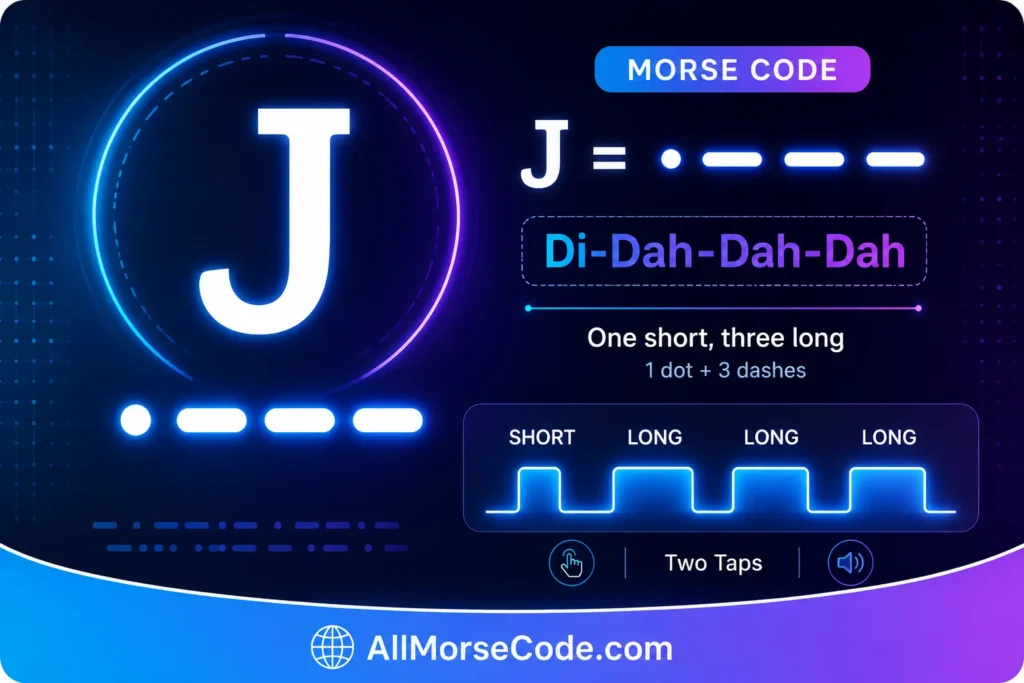
The Morse code for the letter J is:
J = .—
It’s built from four signals — one dot followed by three dashes — always sent in that exact order. Drop or add a single dash and you land on a completely different character (more on that below).
The letter J is part of International Morse Code, the same standardized system covered on the main Morse code guide.
Why Is J So Long? A Letter That’s Younger Than It Looks
J’s length isn’t arbitrary it traces back to the letter’s own unusual history. J is one of the youngest letters in the Latin alphabet: it didn’t exist as a distinct letter from I until medieval scribes began using a swash-tailed “j” to mark a consonant sound, and it didn’t become a fully separate, standardized letter in English until centuries later.
Because J arrived so late and stayed relatively rare in everyday English compared to older letters, it ended up bundled in with the alphabet’s longest, least-efficient Morse codes when the system was designed around letter frequency landing J in the same four-signal tier as Q, X, and Z.
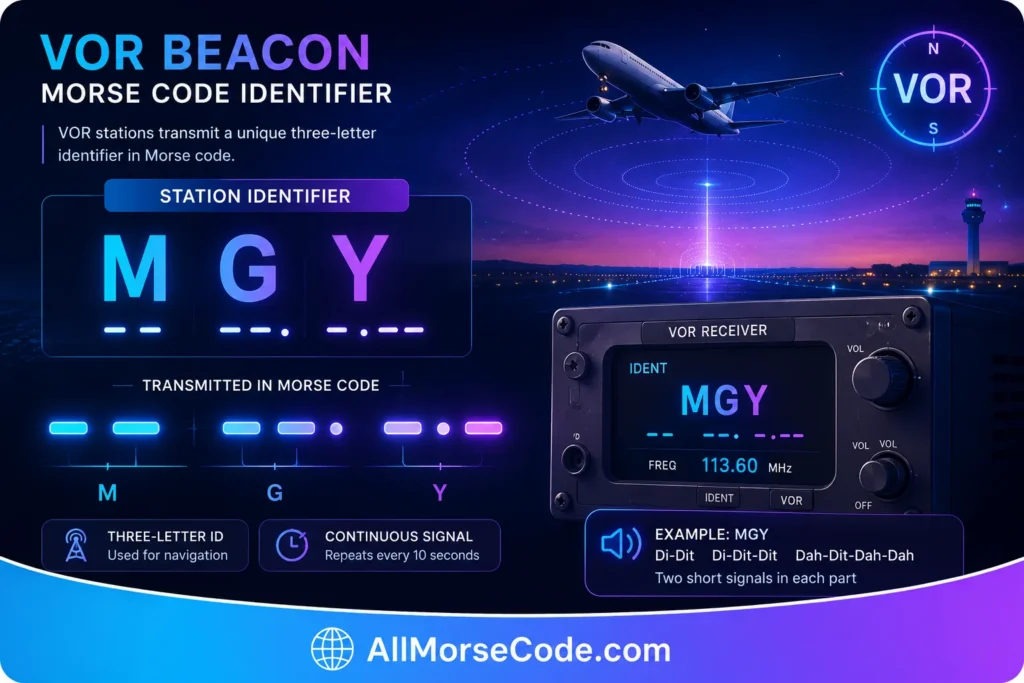
J also has a job today that has nothing to do with spelling. Aviation navigation beacons VOR and NDB stations that guide aircraft continuously broadcast their own three-letter identifier in Morse code on a repeating loop, and plenty of them include a J.
The VOR station at New York’s JFK Airport, for instance, transmits its own “JFK” identifier in Morse every few seconds, meaning J is quite literally being sent over the airwaves around the clock, whether or not a single pilot is actively decoding it by ear.
Quick Reference
Item | Answer |
|---|---|
Letter | J |
Morse Code | .— |
Pattern | One dot + three dashes |
Sound | Di-dah-dah-dah |
Number of signals | 4 |
Timing pattern | 1-3-3-3 |
Also seen in | Aviation VOR/NDB beacon identifiers |
However you’re using it — on paper, out loud, or over a signal — the pattern for J never changes.
Written: .— Spoken rhythm: di-dah-dah-dah (short → long → long → long) Tapped, flashed, or toned: one short pulse, then three long pulses
When J appears next to other letters, a space separates each letter so the pattern stays readable:
JOY = .— — -.–
If reading “.— — -.–” off the page doesn’t click yet, running it through the Morse code audio translator turns it into the actual short-long-long-long tone pattern, and the Morse code image translator will convert any word you type into its dot-dash form so you can see J next to other letters instantly.
Letter J in Morse Code Timing
Timing is what keeps J’s opening dot distinguishable from its three trailing dashes:
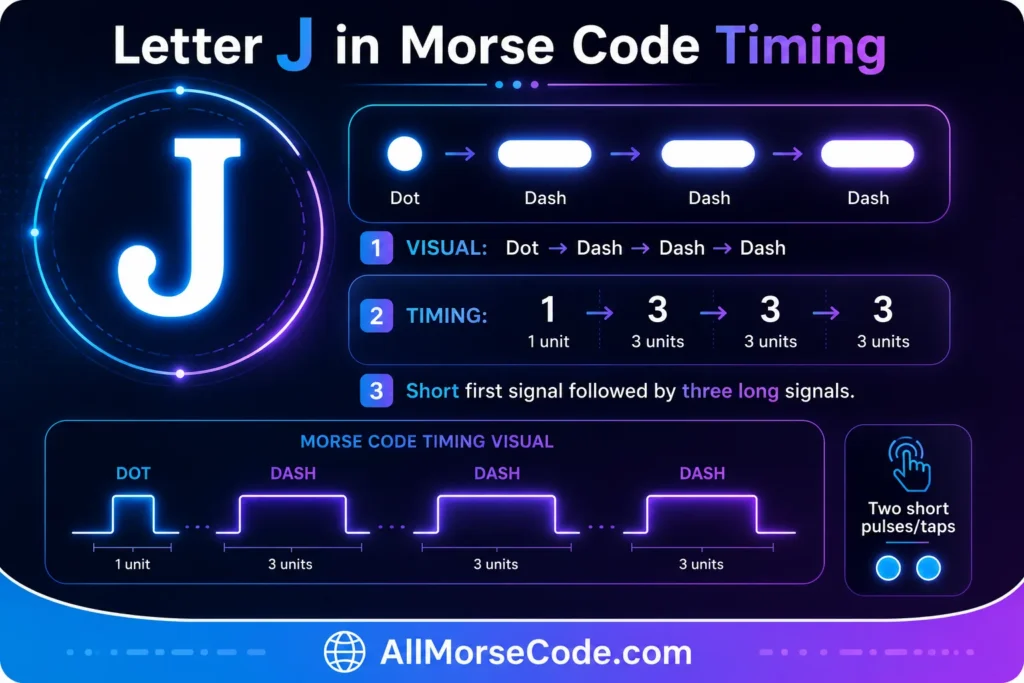
Element | Duration |
|---|---|
Dot | 1 unit |
Each dash | 3 units |
Gap between signals within J | 1 unit |
So the full duration pattern for J reads 1-3-3-3 meaning nearly the entire letter is spent on long signals. Transmission speed can vary, but that ratio stays fixed the same timing system that governs every letter across the full Morse code alphabet, not just J.
Letter J vs. W, the Number 1, and Other Letters Built From a Dot Plus Dashes
The letter J sits inside a clean, useful progression: start with a dot, then keep adding dashes.
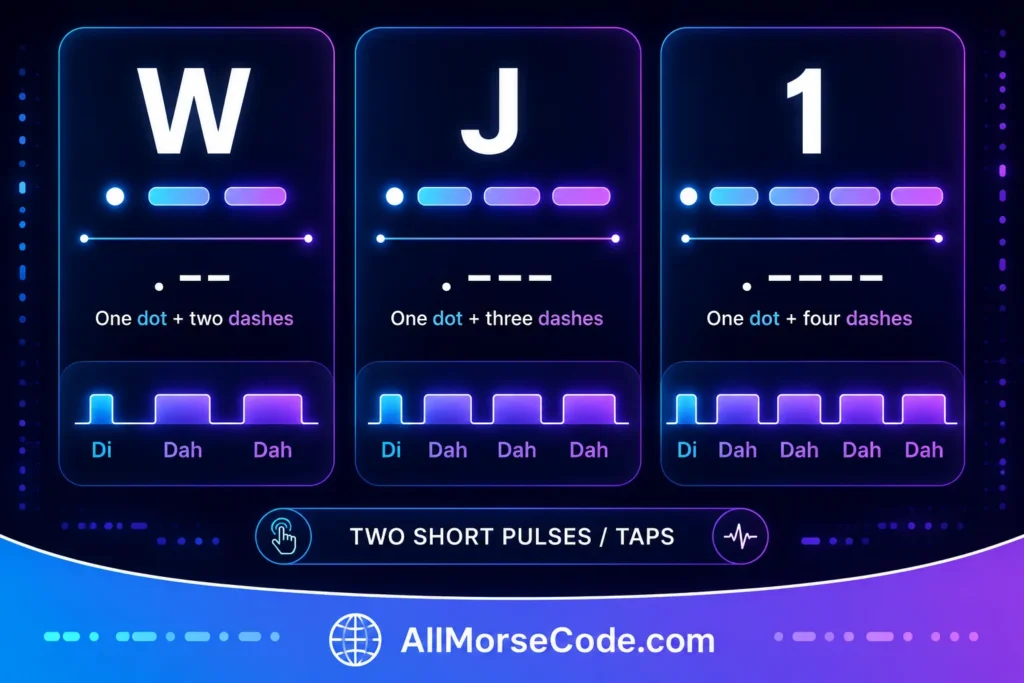
Character | Morse Code | Pattern |
|---|---|---|
W | .– | dot + 2 dashes |
J | .— | dot + 3 dashes |
1 | .—- | dot + 4 dashes |
I | .. | 2 dots |
K | -.- | dash + dot + dash |
The most useful relationship to lock in is the W → J → 1 progression: each one adds exactly one more dash after the same opening dot. Miss the count by one dash in either direction and you’ve landed on a neighboring character. Beyond that progression, J is also easy to separate from I (two short dots vs. one dot and three long dashes) and from K (which opens with a dash, not a dot, ruling it out immediately).
For the complete picture of how J fits alongside every other character, see the full Morse code alphabet.
Letter J in Example Words
The letter J doesn’t change no matter what surrounds it — only the spacing between letters does:
Text | Morse Code |
|---|---|
J | .— |
JOB | .— — -… |
JAM | .— .- — |
JOY | .— — -.– |
These are just a starting point. Once single letters feel automatic, a much larger set of Morse code words is worth practicing. J is also a good letter to notice in the wild it shows up in plenty of pop-culture Morse code moments, including some featured on the site’s look at Morse code in anime. That’s also the point where beginners start wondering how experienced Morse code operators hear words as whole rhythms instead of decoding letter by letter the natural next skill after this one.
Is the Letter J Used in Real Morse Communication?
Yes — J is sent exactly as .— whenever it occurs naturally in a message, no different from any other letter, and as covered above, it’s also quietly at work around the clock inside aviation navigation beacons. J appears inside other abbreviations and shorthand too, and those carry entirely different meanings from the standalone letter. For a broader look at these shorthand combinations, see Morse code abbreviations. J is also unrelated to universally recognized signals like SOS, which is built from S and O, not J.
If you ever want to send J (or a full message) using real equipment instead of just reading it, the guide to Morse code machines covers how physical senders and keys work.
The letter J in Morse code is .— — dot, dash, dash, dash, or di-dah-dah-dah. The fastest way to make it permanent isn’t re-reading the symbol, it’s practicing the rhythm by ear or by tapping especially alongside W and the number 1, its closest look-alikes until .— stops feeling like a code to solve and starts feeling like a sound you simply recognize.