Morse Code Machine: Types, History, How It Works & Buying Guide
Written with input from licensed amateur radio (ham) operators. Last updated July 2026.
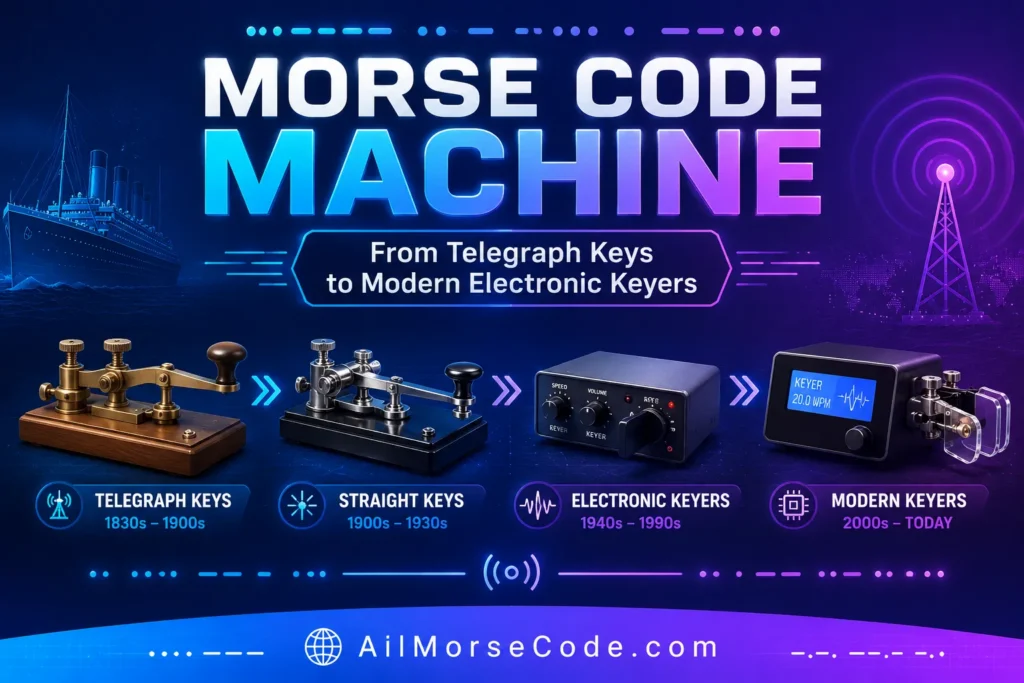
A Morse code machine is a device used to send or practice Morse code by creating short and long electrical signals known as dots and dashes. Although many people search for “Morse code machine,” the correct technical name is telegraph key. These devices have evolved from simple mechanical switches used on telegraph lines in the 1800s to modern electronic keyers and online simulators used by amateur radio operators, collectors, and beginners.
Whether you’re curious about its history, planning to buy your first Morse key, or simply want to understand how it works, this guide covers everything in one place. Before getting started, it’s worth learning the International Morse Code, since every machine mechanical or digital uses the same encoding system for letters, numbers, and symbols.
Key Takeaways
✔ A Morse code machine is commonly called a telegraph key.
✔ It sends Morse code by opening and closing an electrical circuit.
✔ There are six main types: straight keys, bugs, paddles, electronic keyers, practice oscillators, and online simulators.
✔ Modern Morse code machines are still used in amateur radio, education, museums, and by collectors.
✔ Beginners should start with a straight key or an online simulator before investing in advanced equipment.
[ez-toc]
A Morse code machine is a device that allows users to send messages using Morse code. Instead of typing letters directly, the operator presses a key to create short signals (dots) and long signals (dashes). These signals are decoded into letters, numbers, and punctuation according to the International Morse Code standard.
The term “Morse code machine” is widely used by the public, but the device itself is usually called a telegraph key. In traditional telegraph systems, pressing the key completed an electrical circuit, sending signals through a wire to a receiver. Today, electronic versions perform the same function digitally and are popular among amateur radio operators and hobbyists.
You’ll often hear other names for these devices, including:
If you’re new to Morse code, the Morse Code Translator lets you hear how dots and dashes sound before you start practicing with a physical key.
Many beginners assume a Morse code machine and a telegraph key are different devices, but they’re usually referring to the same piece of equipment.
A telegraph key is the manual switch used to create Morse code signals. “Morse code machine” is the broader, non-technical term people use to describe any device that sends, receives, or helps practice Morse code — including:
| Morse Code Machine | Telegraph Key |
| General search term | Technical name |
| May include digital simulators | Physical signaling switch |
| Used by beginners | Used in telegraphy and amateur radio |
For background on how the code itself is structured, see the International Morse Code guide before comparing equipment types.
Pro Tip: When searching online, use both terms — “Morse code machine” and “telegraph key” — to surface a wider range of educational resources and products.
Quick Facts
| Feature | Details |
| Common Name | Morse code machine |
| Technical Name | Telegraph key |
| Primary Purpose | Send Morse code |
| Used By | Amateur radio operators, educators, collectors, hobbyists |
| Communication Method | Electrical or electronic signals |
The history of the Morse code machine began in the 1830s with the invention of the electric telegraph by Samuel Morse and Alfred Vail. Their system transformed electrical pulses into coded messages, allowing information to travel much faster than physical mail.
Early operators used simple straight keys connected to telegraph wires. Pressing the key opened and closed a circuit, sending dots and dashes across long distances. This technology soon became essential for railroads, newspapers, military communication, and maritime navigation.
One of the most famous examples of Morse code in action was the sinking of the RMS Titanic in 1912, when distress operators repeatedly transmitted emergency signals to nearby ships. You can read the full account in Titanic Morse Code Distress Messages.
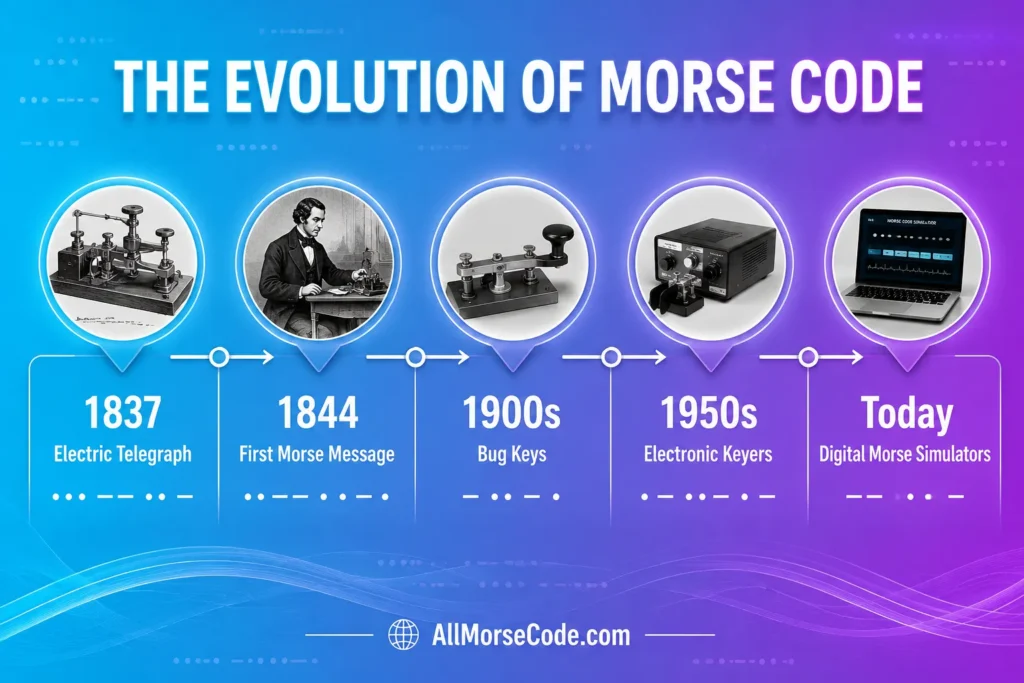
Timeline of Morse Code Machine Development
| Year | Milestone |
| 1837 | Electric telegraph developed |
| 1844 | First public Morse telegraph message |
| Early 1900s | Semi-automatic bug keys introduced |
| Mid-1900s | Electronic keyers become popular |
| Today | Digital keyers, apps, and online simulators widely available |
Although telegraph networks have largely disappeared, Morse code remains active in amateur radio, emergency preparedness, historical preservation, and education.
A Morse code machine works by converting physical key presses into timed electrical or electronic signals. A short press creates a dot (dit); a longer press creates a dash (dah). The sequence and spacing of these signals determine each letter, number, or symbol.
In a traditional telegraph system, pressing the key closed a circuit, sending current through a wire to a receiver called a telegraph sounder, which produced audible clicks the operator translated into Morse code.
Modern electronic keyers simplify this. Instead of manually controlling every dot and dash, they automatically generate perfectly timed signals making learning easier and improving accuracy at higher speeds, measured in words per minute (WPM).
Many beginners improve faster by listening to correctly timed signals while practicing, or by decoding visual signals using the Morse Code Image Translator.
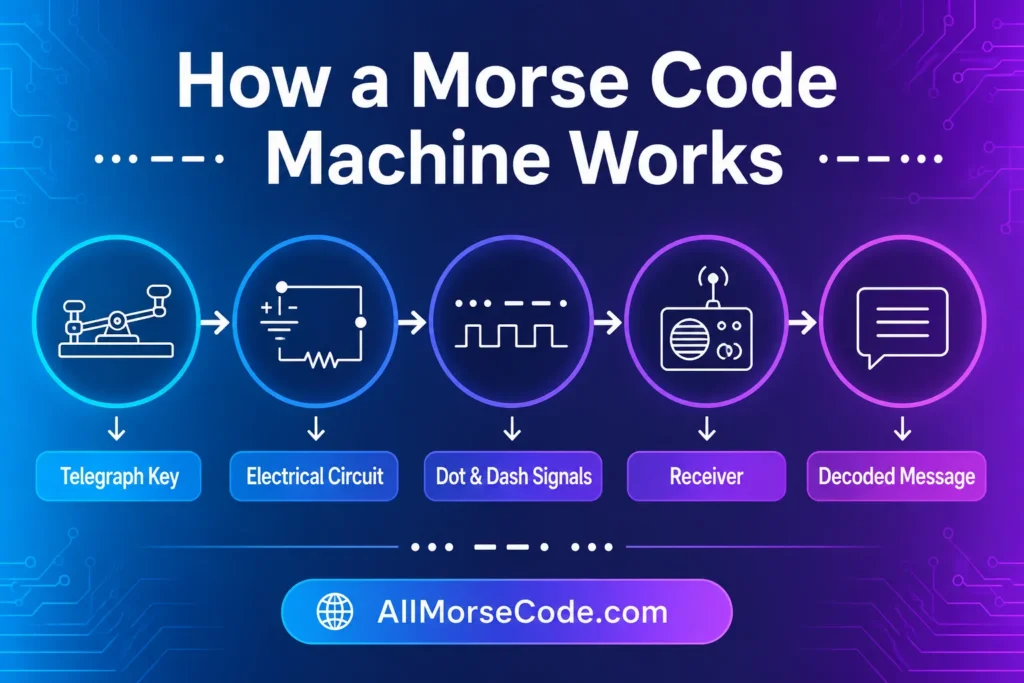
How the Process Works
| Step | What Happens |
| 1 | The operator presses the key |
| 2 | The electrical circuit closes |
| 3 | A dot or dash is transmitted |
| 4 | The receiver reproduces the signal |
| 5 | The listener decodes the message |
Not all Morse code machines work the same way. Some are designed for beginners; others are built for experienced operators sending Morse code at high speed. Choosing the right type depends on your skill level, purpose, and budget.
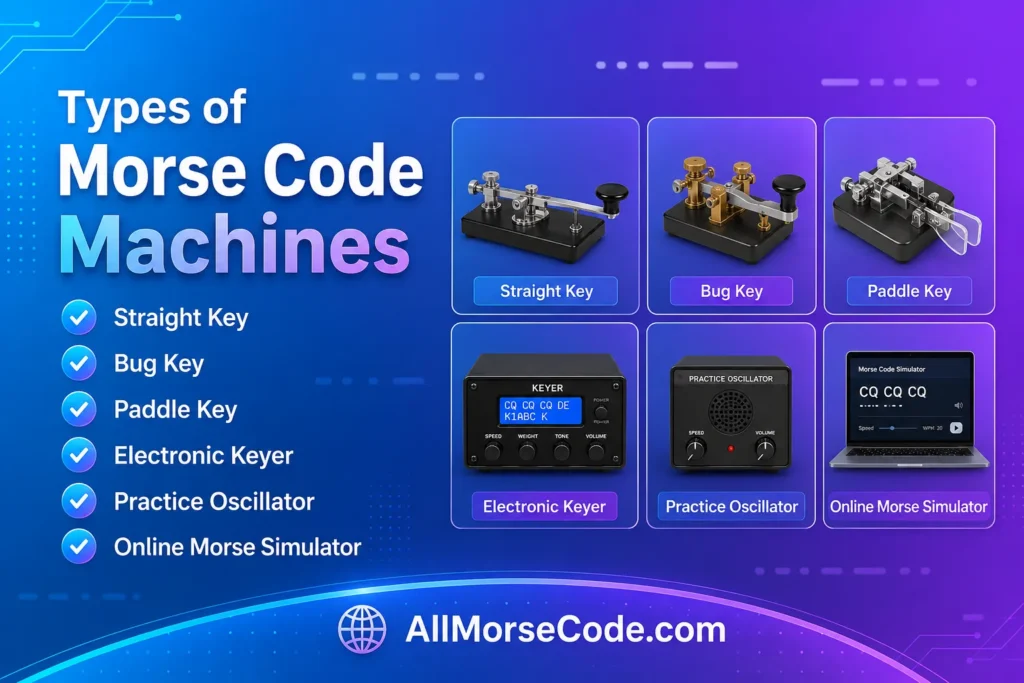
There are six main types:
- Straight Key
- Bug (Semi-Automatic Key)
- Paddle Key
- Electronic Keyer
- Code Practice Oscillator (CPO)
- Online Morse Code Machine
Quick Tip: If you’re learning the Morse alphabet for the first time, practice a few common Morse code words before investing in equipment.
Straight Key
The original Morse code machine and the best choice for beginners. A single lever moves up and down, and every dot and dash is created manually giving the operator complete control over timing. Still widely used in amateur radio training and by collectors.
Bug (Semi-Automatic Key)
Also called a semi-automatic key, a bug speeds up communication by automatically producing dots while the operator manually creates dashes. The best-known manufacturer is Vibroplex, whose bug keys have been used by professional operators for over a century.
Did You Know? Many collectible Vibroplex bug keys have become sought-after antiques because of their craftsmanship and historical significance.
Paddle Key
A paddle key works with an electronic keyer. Instead of manually controlling every signal’s length, you move one or two paddles sideways while the keyer generates perfectly timed dots and dashes. Comes in single-lever and dual-lever (iambic) designs.
Electronic Keyer
An electronic device that automates Morse code timing. It connects to a paddle key and generates correctly spaced dots and dashes, so operators can focus on rhythm instead of manual timing. Many include adjustable speed, memory functions, automatic spacing, practice modes, and built-in tone generators.
Code Practice Oscillator (CPO)
A CPO lets you practice sending Morse code without transmitting radio signals. Pressing the key produces an audible tone through a speaker or headphones — one of the safest ways for beginners to practice, since no radio equipment is required.
Compare the sounds you create with the Morse Code Audio Translator to check your timing and accuracy.
Online Morse Code Machines
Websites and apps that simulate a Morse code machine in your browser, converting keyboard input, mouse clicks, or microphone audio into Morse code often with adjustable speed, pitch, and playback controls. Ideal for learning before buying physical equipment.
If you receive Morse code as an image or screenshot, use the Morse Code Image Translator to decode it while you practice.
| Type | Beginner Friendly | Speed | Typical Price (USD) | Best For |
| Straight Key | ⭐⭐⭐⭐⭐ | Slow | $20–$80 | Learning fundamentals |
| Bug Key | ⭐⭐☆☆☆ | Fast | $100–$500 | Experienced operators |
| Paddle Key | ⭐⭐⭐⭐☆ | Fast | $60–$250 | Amateur radio |
| Electronic Keyer | ⭐⭐⭐⭐☆ | Very Fast | $80–$300+ | Regular CW operation |
| Code Practice Oscillator | ⭐⭐⭐⭐⭐ | Practice Only | $30–$120 | Home learning, classrooms |
| Online Morse Machine | ⭐⭐⭐⭐⭐ | Adjustable | Free–$ | Beginners, casual practice |
Use this single table to compare all six types side by side difficulty, speed, typical price, and who each one suits best.
Learning to use a Morse code machine is easier than most beginners expect. The goal isn’t speed — it’s accurate timing and rhythm. Before practicing with a physical key, get familiar with the International Morse Code so you understand how each letter, number, and symbol is represented.
Step 1: Learn the Morse Code Alphabet
Start with the most common letters:
Learn a few characters a day rather than the whole alphabet at once. Reinforce recognition using real words like Hello in Morse Code or Hi in Morse Code.
Step 2: Practice Sending Dots and Dashes
Hold the key comfortably and press it gently. Basic timing rules:
Consistent spacing matters more than sending quickly.
Step 3: Listen While You Practice
Morse code is learned by both sending and listening. After sending a word, check your rhythm against the Morse Code Audio Translator linked above hearing correctly timed code makes mistakes much easier to spot than practicing silently.
Step 4: Practice Real Words
Once comfortable with individual letters, move on to everyday words and short phrases:
Familiar phrases make learning far more engaging than random character drills.
Common Beginner Mistakes to Avoid
Once you’ve started practicing, watch for these habits — they’re the most common reasons beginners plateau:
If you want to skip the research and just buy something reliable, here’s what’s actually worth considering at each budget level. These are the categories most amateur radio retailers and hobby shops stock — check current listings and reviews before buying, since availability and pricing shift.
Best Free Option: Online Simulator
Start here if you’re not ready to commit any money. Any browser-based Morse trainer with adjustable WPM speed and audio playback will teach you correct timing. Pair it with the Morse Code Audio Translator to build an ear for the rhythm before you ever touch a physical key.
Best Budget Straight Key (Under $40)
Entry-level straight keys from general electronics or ham radio suppliers typically run $20–$40. Look for a solid metal base (so it doesn’t slide on the desk), adjustable spring tension, and clean, corrosion-free contacts. These basics separate a usable key from a frustrating one.
Best Mid-Range Straight Key ($40–$80)
Stepping up to this range usually buys a machined brass lever, smoother action, and better long-term durability worth it if you plan to practice regularly rather than try Morse code once and put it away.
Best Practice Oscillator for Classrooms ($30–$60)
For students or STEM programs, a basic CPO with a built-in speaker and headphone jack is the safest, most affordable option. No radio license or transmitter is needed, and multiple students can practice independently.
Best Paddle + Keyer Combo for Ham Radio Beginners ($150–$300)
Once you’ve mastered a straight key and are ready for amateur radio contesting or faster CW, a dual-lever paddle paired with an entry-level electronic keyer is the standard upgrade path. Expect adjustable speed control and memory functions at this price point.
Buying Checklist (any budget):
Pro Tip: Don’t buy the most expensive key first. Spend time learning rhythm and spacing on a straight key or simulator before upgrading to a paddle or electronic keyer.
Where you shop depends on whether you want a beginner model, a professional key, or a collectible antique.
New Equipment
Used Equipment
Before buying used, check contact wear, lever movement, spring tension, corrosion, and missing components.
| User Type | Recommended Machine |
| Beginner | Straight Key |
| Student | Code Practice Oscillator |
| Ham Radio Beginner | Paddle + Keyer |
| Collector | Vintage Key |
| Museum Display | Antique Telegraph Key |
Although Morse code is no longer used for everyday commercial communication, it remains active in several fields.
Amateur Radio: Thousands of operators continue using Continuous Wave (CW) because it performs well under weak signal conditions.
Emergency Preparedness: Morse code still works as a simple backup communication method when voice isn’t practical. The best-known emergency signal is SOS in Morse Code, recognized worldwide.
Education: Teachers use Morse code to introduce binary thinking, pattern recognition, communication history, electronics, and problem solving.
History and Museums: Museums preserve original telegraph equipment to show how long-distance communication worked before telephones and the internet.
Popular Culture: Morse code also shows up in film, television, games, and animation. See Morse Code in Anime for examples from popular series.
Vintage Morse code machines are valued by collectors, museums, amateur radio enthusiasts, and history lovers. Many were used by railroad companies, military units, telegraph offices, and maritime operators before modern communication systems replaced them.
Collectors often look for original examples from well-known manufacturers such as Vibroplex or historic telegraph suppliers.
What Makes a Vintage Key Valuable?
Machines with verified historical connections command significantly higher prices than common surplus equipment. For a real-world example of how these devices were used under pressure, see Titanic Morse Code Distress Messages.
Morse code is a fun way to introduce children to communication technology, pattern recognition, and basic electronics. Many schools and STEM programs use simple practice keys and oscillators to demonstrate how coded messages work.
Children generally learn faster when lessons involve games and familiar words rather than the full alphabet at once.
Good Activities
Parents can make learning more engaging with simple phrase pages such as Yes in Morse Code, No in Morse Code, and Be Safe in Morse Code.
Safety Tip: Young children should use educational practice kits rather than vintage telegraph equipment with exposed electrical components.
A Morse code machine is more than a piece of historical equipment it’s a practical learning tool that continues to serve amateur radio operators, educators, collectors, and hobbyists. Whether you start with a simple straight key, an online simulator, or an electronic keyer, understanding the fundamentals makes everything after it easier. As you improve, keep practicing with real words, explore how Morse code shaped history through the Titanic distress messages, and reinforce your skills with the audio translator and International Morse Code guides linked throughout this page.