Be Safe in Morse Code (Meaning, Translation & How to Use It)
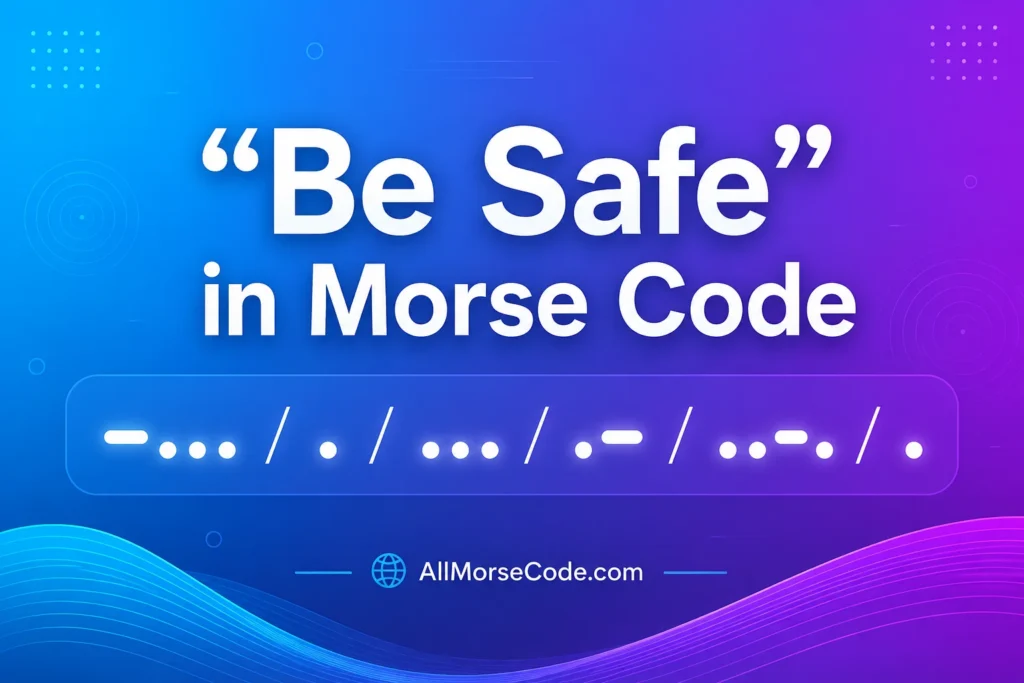
Instant Answer — “Be Safe” in Morse Code:
-… / . / … / .- / ..-. / .
Letter | Morse Code | Pronunciation |
|---|---|---|
B | -… | Dash Dot Dot Dot |
E | . | Dot |
S | … | Dot Dot Dot |
A | .- | Dot Dash |
F | ..-. | Dot Dot Dash Dot |
E | . | Dot |
[ez-toc]
If you’ve searched for “Be Safe in Morse Code,” you’re likely looking for the correct translation to use in a message, project, or as part of learning Morse code. The good news: it’s an easy phrase to master once you understand how each letter is built from dots and dashes.
Morse code is still widely used today for amateur radio, education, emergency preparedness, and historical study. “Be Safe” isn’t an official distress signal but it’s become one of the most popular phrases people learn, largely because it’s short, meaningful, and sent by real people in real situations: a parent tapping it out to a child heading off to camp, a ham radio operator signing off before a storm, a sailor or hiker sending a quick check-in before losing signal. That everyday, human use is exactly what makes it worth learning early.
In this guide, you’ll get the correct translation, a breakdown of each letter, instructions for sending the message by sound, light, or touch, and answers to the questions people ask most.
To say “Be Safe” in Morse code, spell it out letter by letter: B (-…), E (.), S (…), A (.-), F (..-.), E (.) — giving you -… / . / … / .- / ..-. / .
Each slash marks a short pause that separates one letter from the next. Say or send the letters in order, pausing slightly longer between the words “Be” and “Safe” than you do between individual letters.
-… / . / … / .- / ..-. / .
Double-check spacing before using it in a message, tattoo design, or project — proper spacing is what keeps it decodable.
Unlike SOS, “Be Safe” isn’t tied to emergencies — it’s tied to connection. Common real-world uses include:
- Ham radio operators signing off a conversation, especially before bad weather or a long shift
- Campers and scouts learning Morse basics through short, meaningful phrases
- Military families and long-distance couples, who sometimes use it in tattoos, jewelry engravings, or texts as a quiet, coded way of saying “I’m thinking of you”
- Sailors and outdoor enthusiasts flashing a quick light signal before heading out of range
If you want to translate other words or phrases, the Morse Code Translator converts plain text into Morse code instantly.
A quick comparison, since these three get searched together often:
Phrase | Morse Code | Official Signal? |
|---|---|---|
Be Safe | -… / . / … / .- / ..-. / . | No — a personal/friendly message |
Stay Safe | … / – / .- / -.– / … / .- / ..-. / . | No — a personal/friendly message |
SOS | …—… | Yes — international distress signal |
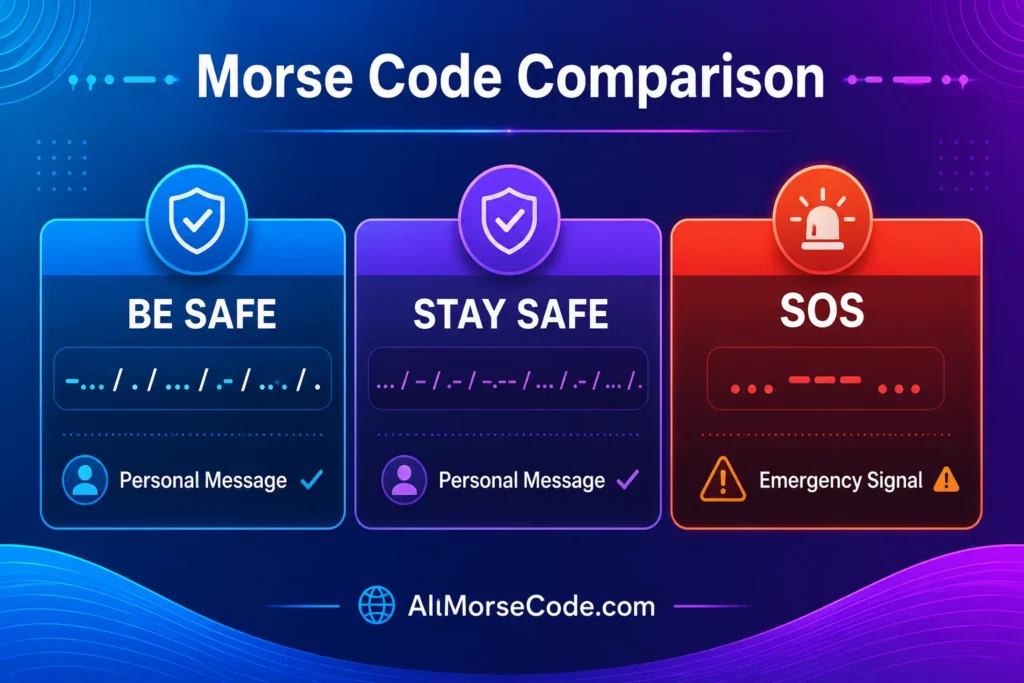
The key distinction: SOS is sent as one unbroken string of dots and dashes with no gaps between letters, precisely so it’s unmistakable in an emergency. “Be Safe” and “Stay Safe” are sent with normal letter spacing, like any other word.
Morse code timing works the same way no matter how you send it:
- A dot = one short signal (tap, flash, or beep)
- A dash = a signal roughly three times as long as a dot
- Pause briefly between symbols in the same letter
- Pause slightly longer between letters
- Leave the longest pause between words
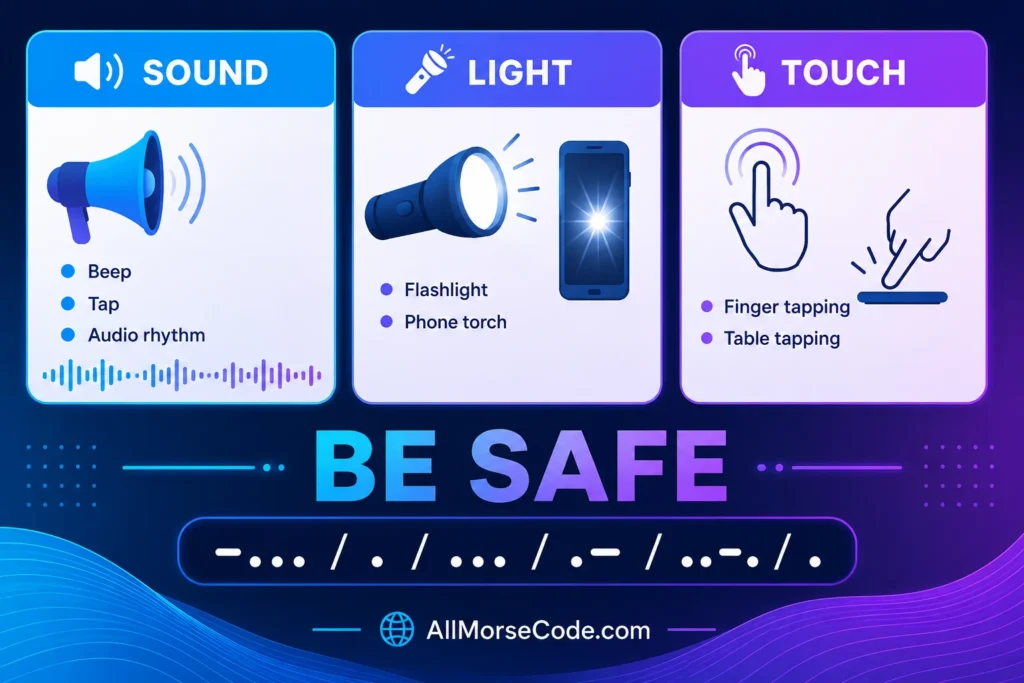
By sound (tapping or beeping)
Tap a short beat for each dot and a longer, held beat for each dash — on a table, a radio key, or using the Morse Code Audio Translator to hear the correct rhythm before you try it yourself.
By light (flashlight or phone torch)
Use a quick flash for a dot and a longer flash for a dash, following the same pause pattern. This method is popular with campers, sailors, and amateur radio operators sending line-of-sight signals. You can also generate a visual version with the Morse Code Image Translator.
Morse Code Timing Rules
Listening and watching the pattern repeatedly — rather than just reading dots and dashes on a page — is the fastest way to internalize the rhythm.
“Be Safe” is a simple, meaningful phrase to learn in Morse code easy enough for beginners, but genuinely used by ham radio operators, campers, and people staying connected over distance. Practice it alongside official signals like SOS so you understand both the personal and the critical uses of Morse code, and use the Morse Code Translator or Audio Translator to build speed and accuracy over time.

Steve Johnson
Founder of AllMorseCode.com and creator of educational Morse code resources used by learners worldwide. Specializes in Morse code translation, signal encoding concepts, communication history, and practical learning methods. Publishes in-depth guides, reference materials, and interactive tools that make Morse code simple, accurate, and accessible for students, amateur radio enthusiasts, emergency preparedness learners, and everyday users.