How Do Experienced Morse Code Operators Hear Words Instead of Dots and Dashes?

Listen to fast Morse code for the first time and it sounds like a wall of noise, a confusing stream of short and long tones with no obvious meaning. It’s hard to imagine anyone following that at speed, let alone understanding full sentences without mentally translating every dot and dash.
Here’s the surprising part: experienced operators aren’t counting dots and dashes at all. After enough practice, their brains stop decoding signal-by-signal and start recognizing whole sound patterns automatically, the same way you recognize a friend’s voice or a familiar word without sounding it out. This article walks through exactly how that shift happens, the stages every learner passes through to get there, and how long it realistically takes.
If you want the fundamentals first (the alphabet, spacing rules, and history), start with our complete Morse code guide. This article picks up from there and focuses on one specific question: how does listening actually become effortless?
[ez-toc]
The Letter-by-Letter Bottleneck
Nearly every beginner starts the same way: memorize the Morse code alphabet, then mentally match each incoming sound to a letter.
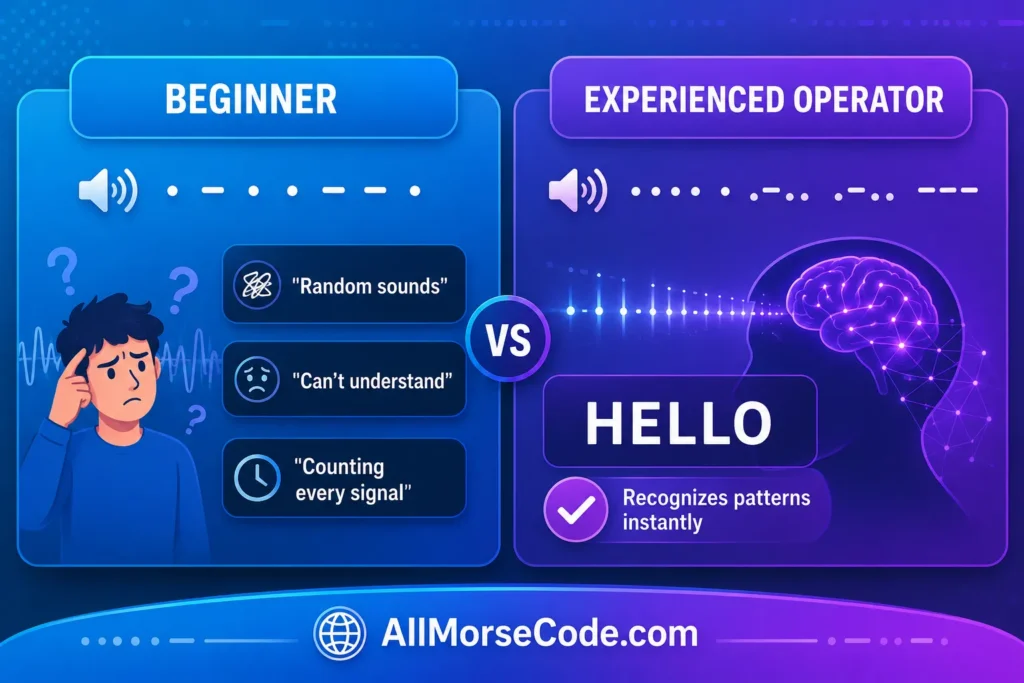
Every signal triggers the same internal question: Was that a dot or a dash? How many were there? That constant translation is a bottleneck: the brain is solving a small puzzle for every single character instead of listening naturally. It’s the audio equivalent of a child sounding out each letter of a word before recognizing it as a whole.
Why Counting Breaks Down at Higher Speeds
Counting works fine when Morse is sent slowly. But once transmission speed climbs, there’s no longer enough time to consciously identify each element.
Picture someone spelling out C-A-T in a normal conversation. You’d understand it, but it would feel unnaturally slow. Now imagine that at speed. Somewhere around 15–20 words per minute, counting individual symbols stops being physically possible; there just isn’t time. This is the point where operators either plateau or make the shift to hearing letters as single, complete sounds instead of sequences of signals. That shift is the biggest milestone in learning Morse code by ear.
Almost every operator who reaches real listening fluency passes through the same four stages. Knowing which one you’re in tells you exactly what to work on next.
Stage 1: Memorizing the Alphabet
Every learner starts by pairing each letter with its dot-dash pattern. This builds the foundation, but memorization alone won’t help you follow a real transmission; it only tells you what to listen for.
Stage 2: Recognizing Letters by Sound
After enough listening, individual letters start registering as single sounds rather than sequences you have to decode. This is usually the first moment Morse code stops feeling like math.
Stage 3: Recognizing Whole Words
As listening skill builds further, entire common words start standing out as one recognizable sound shape, with no letter-by-letter processing at all. Practicing with frequently used vocabulary speeds this stage up considerably; our 100 common Morse code words list is built for exactly this kind of drilling.
Stage 4: Head Copy
The final stage is called head copy: understanding a message directly in your mind as it arrives, without writing anything down. At this point Morse code stops feeling like a code and starts feeling like a second language you simply understand.
The shift from counting to hearing isn’t a trick; it’s the same mental process behind recognizing a favorite song after two notes, or knowing which app just pinged your phone without looking. That process is called pattern recognition, and your brain already uses it constantly; Morse code just becomes one more library entry.
Building a Library of Sound Chunks
Early on, every signal requires conscious effort: dot, dash, dot, that’s A. With repeated exposure, the brain compresses that whole process into a single instant recognition: it simply hears “A.” Later it hears “AND.” Eventually it hears entire phrases without ever consciously separating them into letters. This is the exact shortcut fluent readers use to process hundreds of words a minute without sounding out individual letters; Morse code listening develops the same way, through repetition rather than effort.
Why This Only Works With Real Listening Practice
This shift can’t happen by staring at a chart. Pattern recognition is built by hearing real signal timing over and over until the rhythm becomes familiar. The length of each dot and dash, and the spacing between them, is what actually carries the pattern your brain learns to recognize. Charts teach you what to listen for; only listening teaches your brain to recognize it automatically.
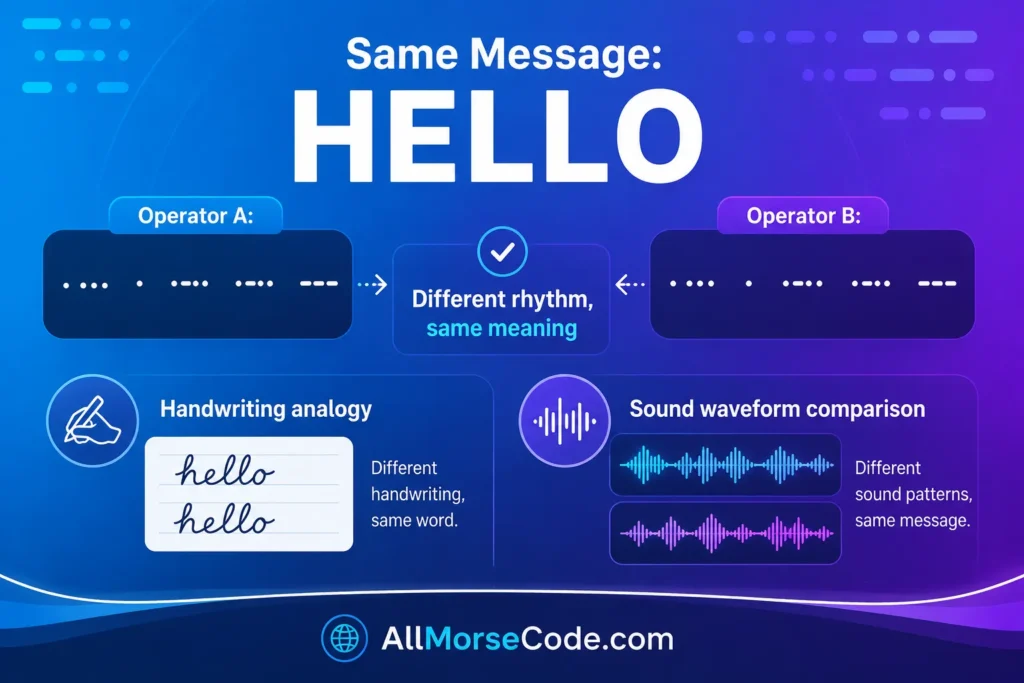
Every sender has a personal rhythm and spacing style called their fist, similar to handwriting or a speaking voice. Even though everyone follows the same timing rules, small variations make each operator’s transmissions distinct. Experienced listeners often recognize who is sending a message before they’ve even decoded the words, purely from the shape of their fist.
A widely recognized example of a fixed, unmistakable rhythm is SOS in Morse code: three short, three long, three short, instantly identifiable regardless of who’s sending it.
There’s no fixed timeline, but most learners follow a broadly similar curve:
Consistency matters more than volume. 15–20 minutes of focused daily listening tends to build recognition faster than an occasional multi-hour session. Progress also isn’t linear: it’s normal to recognize a letter perfectly one day and struggle with it the next. That’s the brain still consolidating the pattern in the background, not a sign you’re doing something wrong.
The ability to hear whole words instead of counting dots and dashes isn’t a special talent; it’s what happens naturally when the brain gets enough repeated exposure to real Morse rhythm. Push through the four stages, prioritize listening over chart-memorizing, and give it consistent daily practice, and decoding eventually stops feeling like translation and starts feeling like understanding a language.
Ready to start building that recognition? Try converting your own words and phrases with our free Morse code translator and listen to the rhythm of real messages using the built-in audio player.

Steve Jhonson
Founder of AllMorseCode.com and creator of educational Morse code resources used by learners worldwide. Specializes in Morse code translation, signal encoding concepts, communication history, and practical learning methods. Publishes in-depth guides, reference materials, and interactive tools that make Morse code simple, accurate, and accessible for students, amateur radio enthusiasts, emergency preparedness learners, and everyday users.