Help in Morse Code: Translation, Blinking, Tapping, Light Signals & Examples
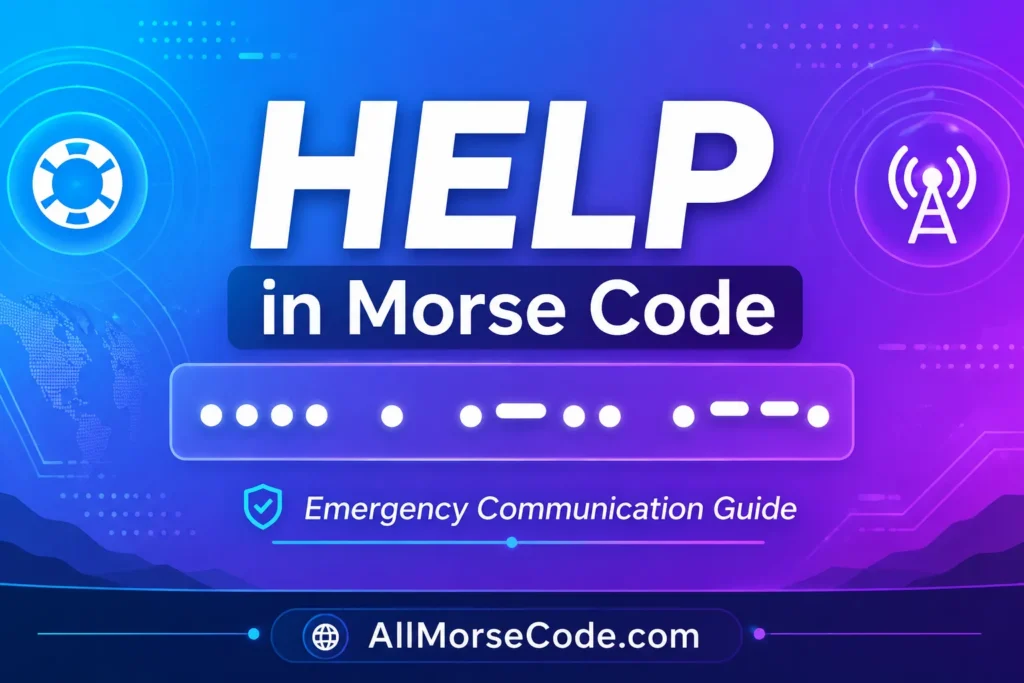
Whether you’re learning Morse code, preparing for emergencies, or just curious, knowing how to write HELP in Morse code is a useful skill. This guide covers the code itself, plus how to send it using sound, light, tapping, or blinking — and explains why SOS, not HELP, is the internationally recognized distress signal under the ITU Radio Regulations.
Key Takeaways
Phrase | Morse Code |
|---|---|
HELP | …. . .-.. .–. |
HELP ME | …. . .-.. .–. — . |
I NEED HELP | .. -. . . -.. …. . .-.. .–. |
SEND HELP | … . -. -.. …. . .-.. .–. |
[ez-toc]
The word HELP in Morse code is:
…. . .-.. .–.
Letter | Morse Code | Pronunciation |
|---|---|---|
H | …. | Di Di Di Di |
E | . | Di |
L | .-.. | Di Dah Di Di |
P | .–. | Di Dah Dah Di |
Each letter has a unique dot-dash pattern; combined in order, they spell HELP. This is the reference table for the rest of the guide — later sections build on it rather than repeating it.
If you’re new to this, it’s worth taking a few minutes to learn how Morse code works before practicing full words. You can also explore common Morse code words to build familiarity.
Need a quick copy-paste version? Use these:
Want to convert your own words or phrases instead? Convert text to Morse code with audio, or translate Morse code from an image if the code appears in a photo or screenshot.
If you can’t speak, three physical methods work anywhere: eye blinking, tapping, and light signaling. All three follow the same core rule — short = dot, long = dash, with a brief pause between letters and a longer pause between words.
Blinking: A short blink is a dot, a longer held blink is a dash. Useful when you can’t move or make noise at all.
Tapping: A quick tap is a dot; a held tap (or a clearly longer knock) is a dash. This method has historically been used to communicate through walls, pipes, or prison cells, and remains popular with survival enthusiasts.
Flashlight: A brief flash is a dot; holding the light on longer is a dash. This is the most practical option for long-distance signaling at night — camping, hiking, boating, or during a power outage.
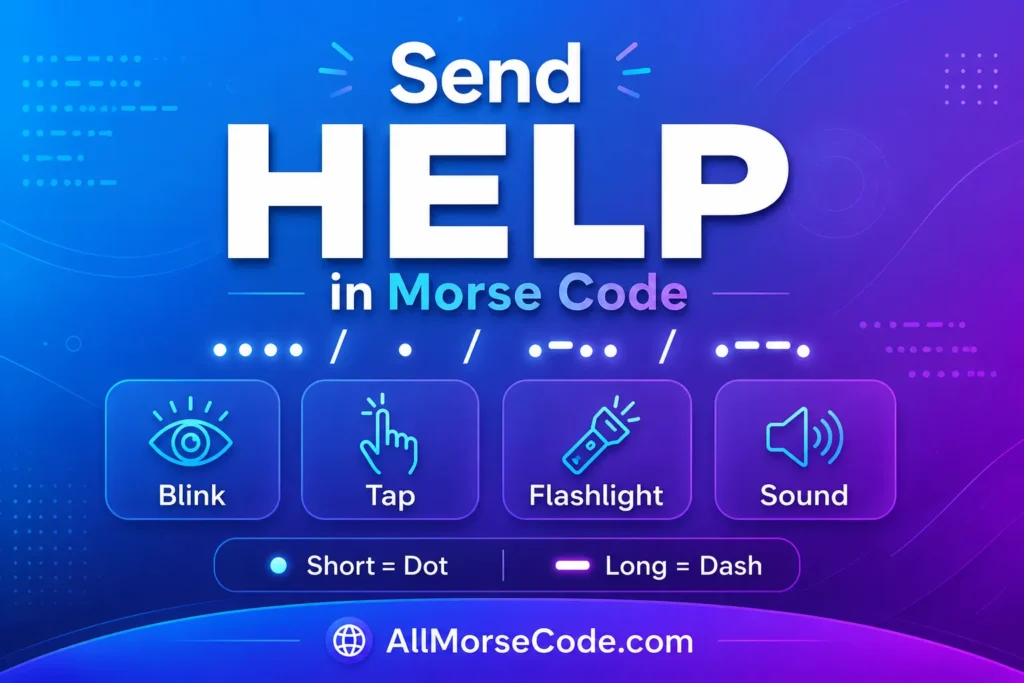
Here’s how the letter H looks across each method, as an example (apply the same logic to E, L, and P using the breakdown table above:
Method | Pattern for H (….) | Best For |
|---|---|---|
Blink | 4 short blinks | Silent, can’t move |
Tap | Tap • Tap • Tap • Tap | Through walls/pipes |
Flashlight | Flash • Flash • Flash • Flash | Long distance, night |
Sound | Beep • Beep • Beep • Beep | Radio, practice |
Consistency matters more than speed — a steady, even rhythm is far easier to read than fast, uneven signals.
Important: while any of these methods can communicate HELP, the internationally recognized emergency signal is SOS (… — …). Learn the SOS distress signal before relying on Morse code in a real emergency. For a real-world case study, read about the Titanic’s Morse code distress messages.
Morse code is also commonly sent as audio: short beeps for dots, longer beeps for dashes. Standard timing is:
Signal | Length |
|---|---|
Dot | 1 unit |
Dash | 3 units |
Space between symbols | 1 unit |
Space between letters | 3 units |
Space between words | 7 units |
Listen to Morse code with audio to hear the rhythm yourself. With practice, experienced operators stop decoding letter-by-letter and start recognizing entire words by ear you can read more in how experienced Morse code operators hear words.
HELP ME in Morse Code
…. . .-.. .–. — .
This is HELP (…. . .-.. .–.) plus ME (– .). It’s a common search for people learning Morse code or practicing emergency communication but for genuine emergencies, SOS is still the standard. If you’re building your everyday vocabulary, try Hello in Morse code or Hi in Morse code next.
I NEED HELP in Morse Code
.. -. . . -.. …. . .-.. .–.
Useful for practice, but in a real emergency, repeatedly sending the shorter SOS is faster and more universally recognized than spelling out a full sentence. Want more vocabulary? Browse more Morse code words or learn Be Safe in Morse code.
SEND HELP in Morse Code
… . -. -.. …. . .-.. .–.
This is SEND (… . -. -..) plus HELP (…. . .-.. .–.). It works well when both parties know Morse code, but in a time-critical emergency, SOS remains the faster, more recognizable choice.
HELP vs. SOS in Morse Code
People often assume HELP and SOS mean the same thing — they don’t.
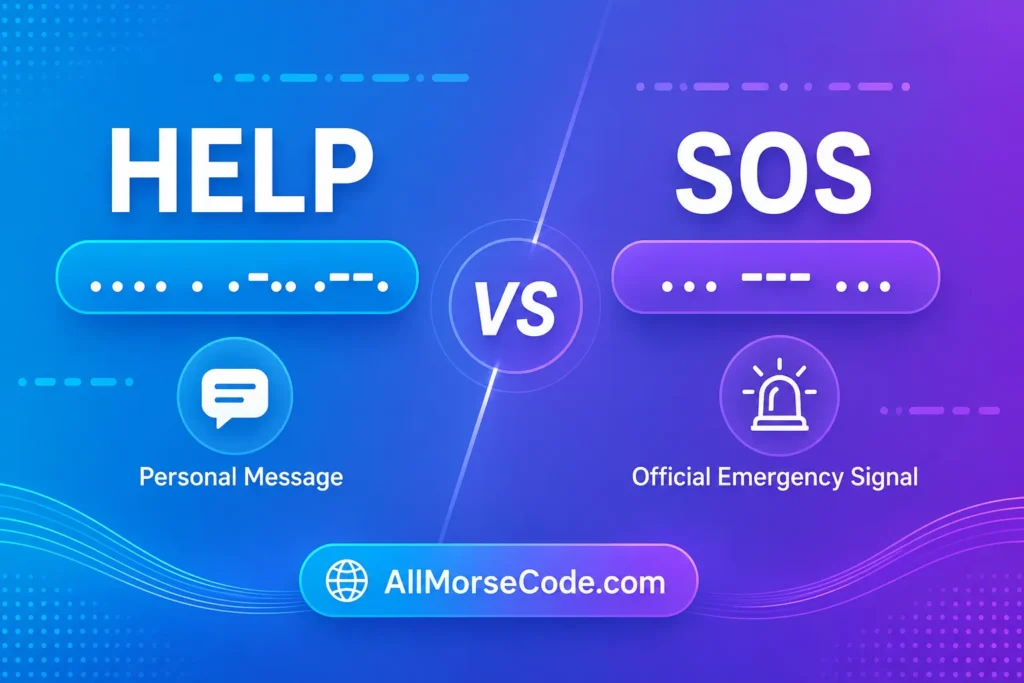
HELP | SOS |
|---|---|
Spells the word “HELP” | Official international distress signal |
Four letters | Three letters |
Best for learning or general messages | Best for real emergencies |
May not be instantly recognized | Universally recognized by rescuers worldwide |
SOS in Morse code is … — …. It was adopted as the international distress signal specifically because it’s short, symmetrical, and easy to recognize under stress — by light, sound, or radio.
Phrase | Best Use Case |
|---|---|
HELP | General request for assistance |
HELP ME | Clear, personal request |
SEND HELP | Asking someone to get assistance |
SOS | Official emergency distress signal |
For the full explanation, learn everything about SOS in Morse code. For history, read how Morse code was used on the Titanic.
Learning HELP in Morse code — …. . .-.. .–. — is a practical way into Morse more broadly. Whether you’re practicing as a hobby, preparing for the outdoors, or just curious, mastering HELP, HELP ME, and SEND HELP is a solid starting point. Just remember: if you’re ever in a real emergency, SOS (… — …) is the signal that’s actually recognized and expected by rescuers worldwide.

Steve Johnson
Founder of AllMorseCode.com and creator of educational Morse code resources used by learners worldwide. Specializes in Morse code translation, signal encoding concepts, communication history, and practical learning methods. Publishes in-depth guides, reference materials, and interactive tools that make Morse code simple, accurate, and accessible for students, amateur radio enthusiasts, emergency preparedness learners, and everyday users.