Yes in Morse Code (+ Copy and Paste, Pronunciation & No Comparison)
Most people expect Morse code words to be difficult to memorize, but “yes” is actually one of the easiest. Because the word combines three very different signal patterns, many beginners can recognize it after only a few minutes of practice. “Yes” in Morse code is -.– . …
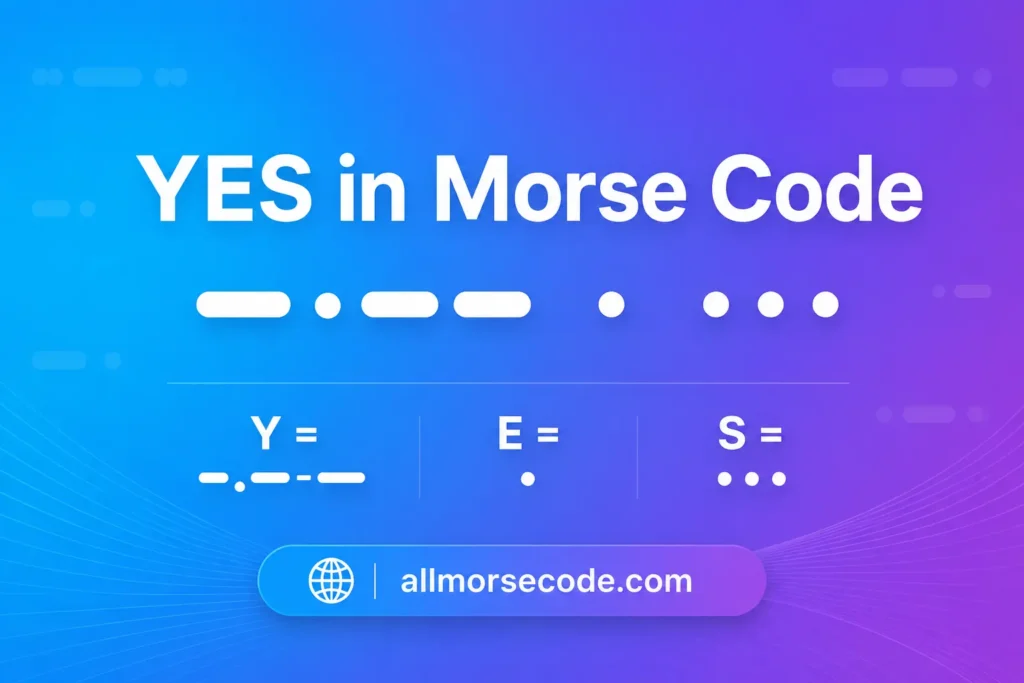
The word is made up of three letters: Y (-.–), E (.), and S (…). If you came here looking for a quick answer, that’s the complete Morse code for “yes.” But if you’re learning Morse code for the first time, it’s worth spending a minute understanding why this word is so easy to recognize and remember.
Unlike longer Morse code phrases, “yes” combines three very different signal patterns. You get the longer rhythm of Y, the single-dot simplicity of E, and the rapid three-dot pattern of S. That combination makes it one of the easiest everyday words for beginners to practice and identify.
Word | Morse Code |
|---|---|
Yes | -.– . … |
[ez-toc]
The Morse code for “yes” is:
-.– . …
Here’s how the word breaks down:
Letter | Morse Code |
|---|---|
Y | -.– |
E | . |
S | … |
If you’re unfamiliar with individual Morse code characters, reviewing the Morse code alphabet can make this pattern much easier to understand.
When these three Morse code characters are combined with spaces between them, they form the complete word “yes.”
Morse code works by assigning a unique pattern of dots and dashes to every letter. Because Y, E, and S each have very different patterns, the word becomes surprisingly easy to recognize once you’ve seen or heard it a few times.
Most people expect Morse code words to be difficult to memorize, but “yes” is actually one of the easiest. Because the word combines three very different signal patterns, many beginners can recognize it after only a few minutes of practice. .
Think of “yes” as three separate sound blocks:
Letter | Rhythm |
|---|---|
Y | Long – Short – Long – Long |
E | Short |
S | Short – Short – Short |
Instead of focusing on the symbols, try listening to the pattern:
Y → E → S
Long-short-long-long → short → short-short-short
The contrast between the letters helps the word stand out, which is one reason Morse code learners often remember “yes” faster than many other common words.
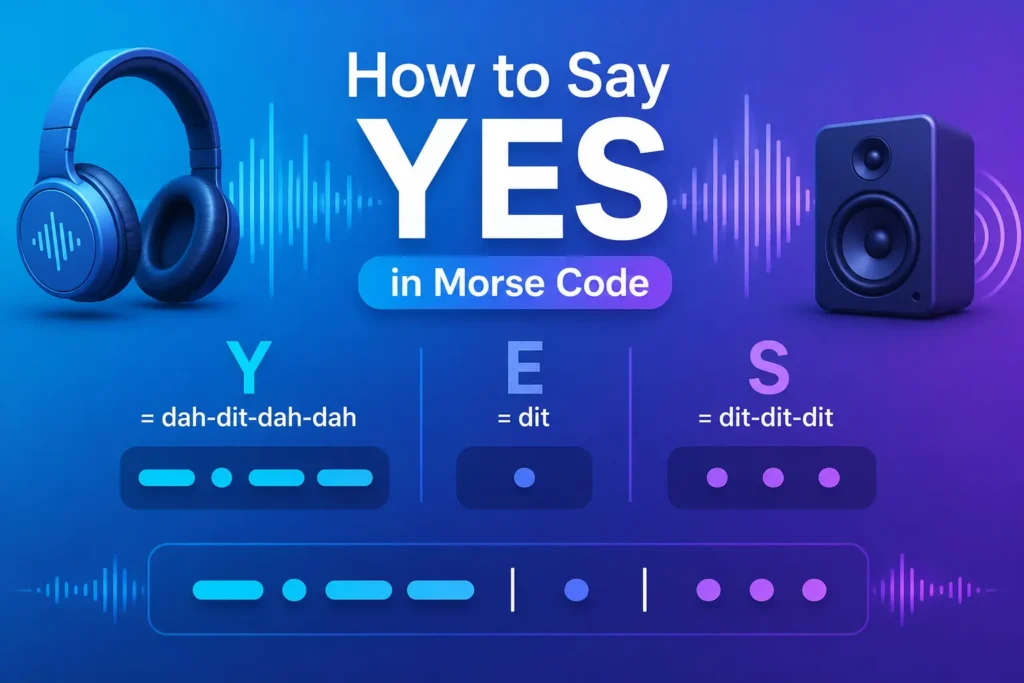
Morse code can be spoken using the sounds dit (for dots) and dah (for dashes).
To say “yes” aloud:
Letter | Morse Code | Spoken Form |
|---|---|---|
Y | -.– | dah-dit-dah-dah |
E | . | dit |
S | … | dit-dit-dit |
When spoken together:
dah-dit-dah-dah | dit | dit-dit-dit
This method is commonly used during Morse code practice because it helps learners connect written symbols with recognizable sound patterns.
If you want to convert longer words or sentences, try the Morse code translator
To type “yes” in Morse code manually:
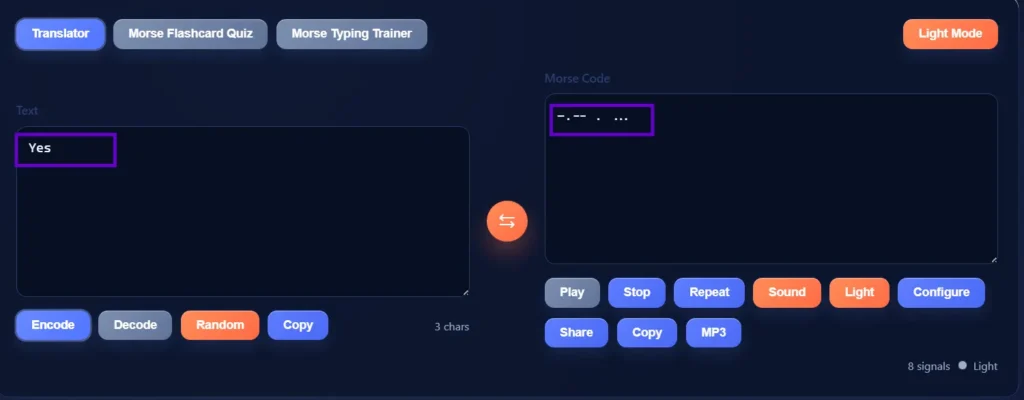
Final result:
-.– . …
The spaces between letters are important because they help separate individual Morse code characters and improve readability.
Need a version you can quickly copy?
-.– . …
Letter-by-letter version:
Y = -.–
E = .
S = …
This format is useful for messages, artwork, tattoos, puzzles, educational activities, and Morse code practice sheets.
You can also scan Morse patterns from images using our Morse code image translator.
Y in Morse Code
The letter Y is written as:
-.–
Y starts with a dash, followed by a dot, and ends with two dashes. It’s the longest part of the word “yes” and usually the section learners spend the most time memorizing.
E in Morse Code
The letter E is written as:
.
E is the shortest letter in International Morse Code. It consists of a single dot and acts as a simple pause between the more complex patterns of Y and S.
S in Morse Code
The letter S is written as:
…
Three quick dots form the letter S. Because of its simple pattern, S is one of the easiest Morse code characters to recognize by both sight and sound.
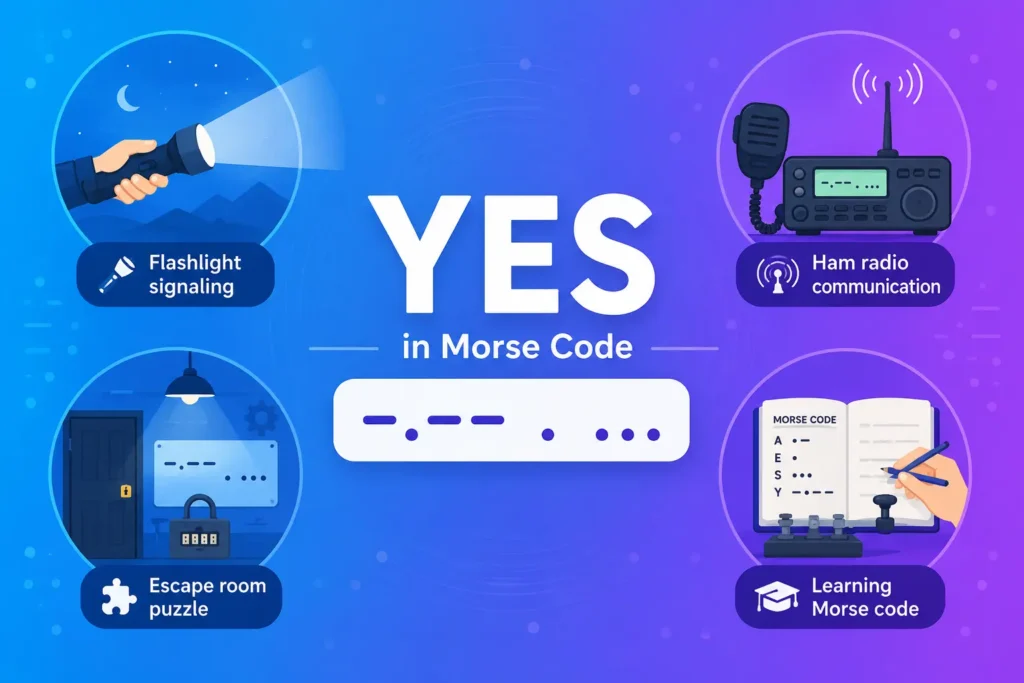
While most people learn Morse code as a hobby, there are several situations where knowing simple words like “yes” can be useful.
For example:
Because “yes” is short and easy to remember, it is often one of the first complete words beginners learn after mastering individual letters.
Once you’ve learned “yes,” it’s easier to expand your Morse code vocabulary with other common words and phrases. Many beginners learn greetings first, followed by emergency signals and meaningful personal messages.
Each page focuses on a specific phrase, helping you learn common Morse code words without overwhelming you with unnecessary information.
People searching for “yes” often want to know the Morse code for “no” as well.
The Morse code for “no” is:
-. —
Breakdown:
Letter | Morse Code |
|---|---|
N | -. |
O | — |
Together, these two words cover the most common positive and negative responses used in Morse code communication.
The Morse code for “yes” is -.– . …, combining the patterns for Y, E, and S into a short but memorable word. Because it uses a mix of long and short signals, it’s often easier to recognize than many beginners expect. Once you’re comfortable with “yes,” learning other common Morse code words becomes much more manageable, and you’ll start recognizing patterns rather than memorizing individual dots and dashes.