Goodbye in Morse Code: Exact Translation & Hidden 73 Meaning
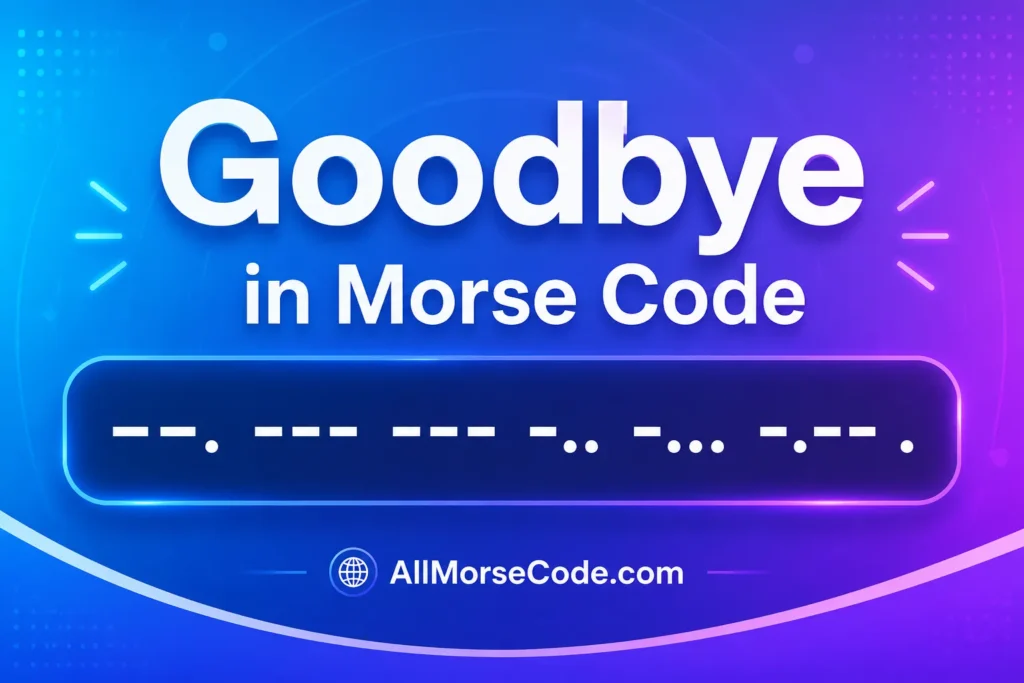
If you’re looking for the correct way to write good bye in Morse code, the answer is:
–. — — -.. -… -.– .
Each group of dots and dashes represents a letter in the word GOODBYE using the International Morse Code standard, a system first developed by Samuel Morse and Alfred Vail in the 1830s and still taught today. Whether you’re learning Morse code for fun, practicing amateur radio, creating a hidden message, or designing a personalized gift, knowing the correct sequence ensures your message is accurate and easy to understand.
You may also have noticed that Google sometimes shows 73 when you search for “goodbye in Morse code.” While it’s related to saying goodbye, 73 is not the Morse code spelling of the word “goodbye.” It’s a long-standing telegraph and amateur radio shorthand that means “Best regards.” Later in this guide, we’ll explain exactly why the two get confused and when to use each one.
Key Takeaways
[ez-toc]
The Morse code for GOODBYE is:
–. — — -.. -… -.– .
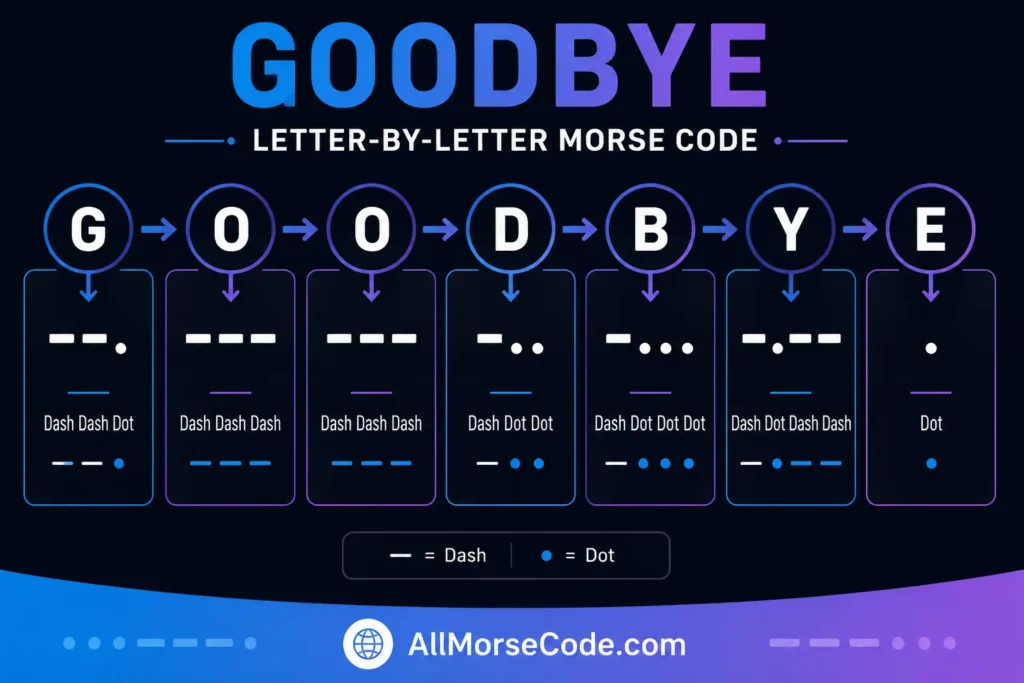
Here’s the complete letter-by-letter breakdown:
Letter | Morse Code |
|---|---|
G | –. |
O | — |
O | — |
D | -.. |
B | -… |
Y | -.– |
E | . |
If you’re new to Morse code, learning the Morse code alphabet first will make it much easier to recognize complete words instead of decoding one letter at a time.
How to Memorize Goodbye in Morse Code
Instead of trying to memorize the entire word at once, break it into individual letters.
Start with:
- G → –.
- O → —
- O → —
- D → -..
Once those four letters feel familiar, add:
- B → -…
- Y → -.–
- E → .
Most beginners learn faster by practicing one or two letters at a time rather than the entire sequence.
This is the most common point of confusion when searching for “goodbye in Morse code,” so it’s worth explaining clearly, once.
GOODBYE is a complete English word, spelled out letter by letter in Morse code. Anyone learning Morse code, writing a message, or making a personalized gift would use this full spelling.
73 is a different thing entirely: a numeric telegraph code that predates modern amateur radio. Landline telegraph operators used numbered codes to save time instead of spelling out full phrases. Over time, amateur (ham) radio operators adopted 73 as a fast, universally understood way to end a conversation politely — and it stuck. Today it’s generally accepted to mean:
According to the American Radio Relay League (ARRL), 73 remains one of the oldest surviving pieces of operator shorthand still used in ham radio today.
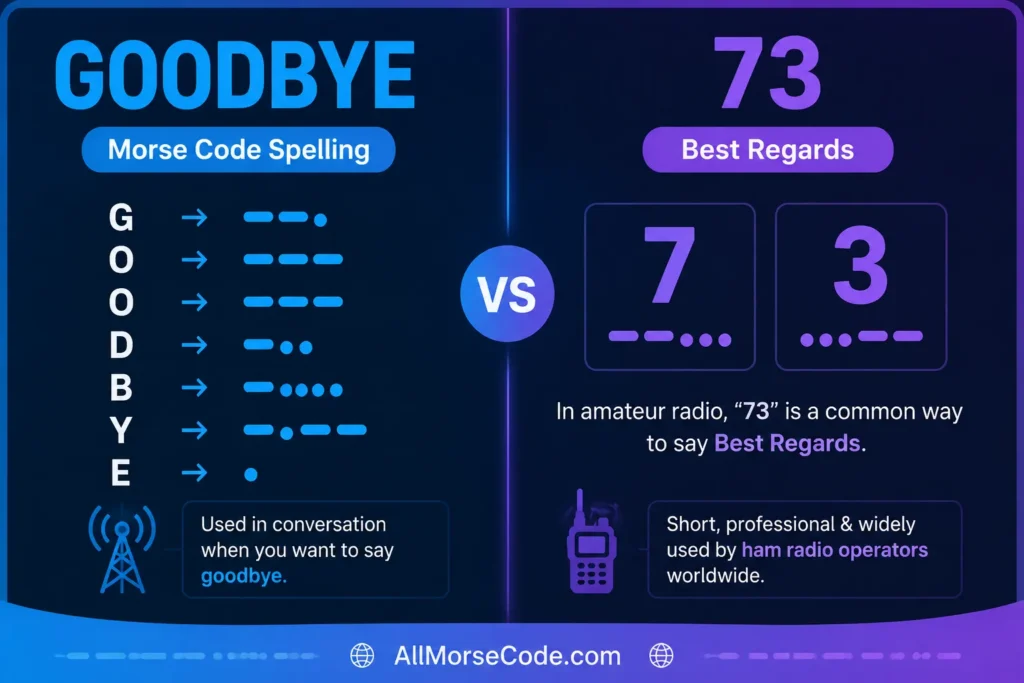
Words | Goodbye | 73 |
|---|---|---|
What it is | A complete English word | A telegraph number code |
How it’s sent | Spelled letter by letter | Sent as two numbers |
Who uses it | Anyone learning Morse code | Mostly amateur radio operators |
Meaning | Literally “goodbye” | “Best regards” |
Best for | Messages, projects, learning, gifts | Ending a radio contact |
Use GOODBYE when: learning Morse code, writing messages, creating gifts or tattoos, practicing the alphabet.
Use 73 when: talking with amateur radio operators, ending a radio contact, following ham radio tradition.
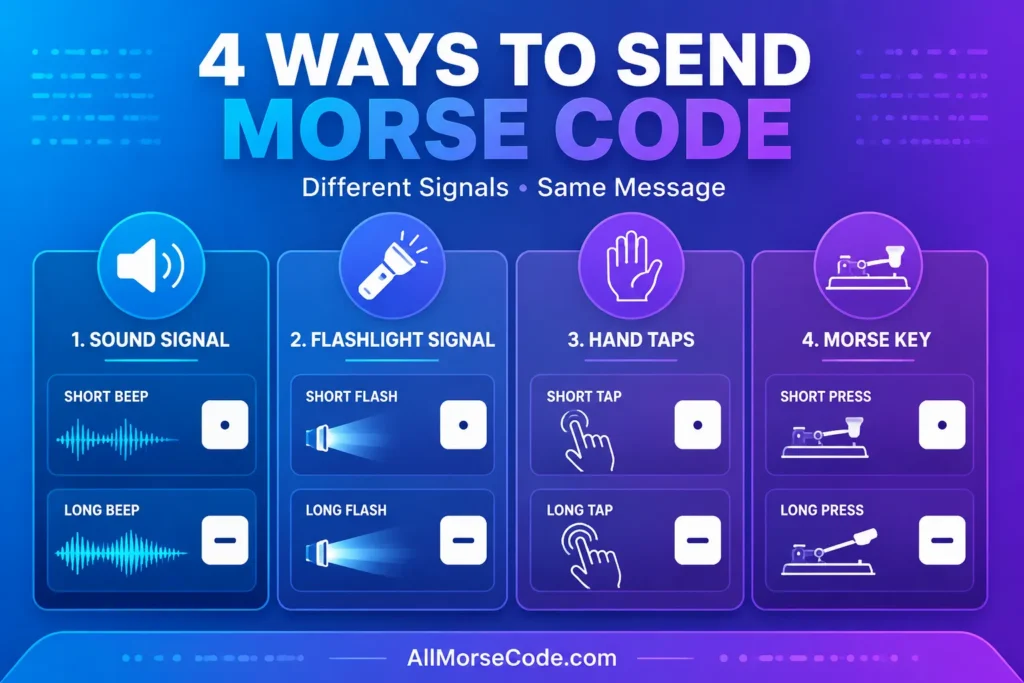
Once you’ve memorized the pattern, the dots and dashes for GOODBYE stay exactly the same — only the method of producing them changes. Here’s a quick comparison of the most common methods:
Method | Dot | Dash | Best for |
|---|---|---|---|
Sound (key or beeper) | Short beep | Long beep | Amateur radio, telegraph practice |
Flashlight / visual signal | Quick flash | Longer flash | Camping, scouting, night signaling, emergencies |
Tapping | Quick tap | Longer tap | Building timing and muscle memory |
Morse key or paddle | Short press | Long press | Traditional telegraph/radio transmission |
Keep a short pause between symbols and a slightly longer pause between letters, regardless of method. If you’d like to hear the correct rhythm before practicing on your own, the Morse Code Audio Translator lets you listen to words exactly as they’re transmitted. If you ever receive Morse code as an image instead of text, the Morse Code Image Translator can help decode it.
Morse Code Timing Rules
Understanding timing is just as important as memorizing the symbols.
Signal | Duration |
|---|---|
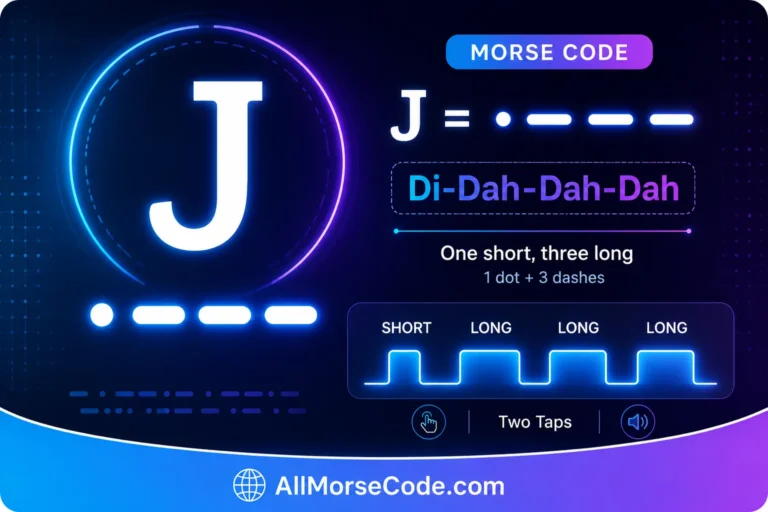
Dot (.) | 1 unit |
Dash (-) | 3 units |
Space between dots/dashes in the same letter | 1 unit |
Space between letters | 3 units |
Space between words | 7 units |
Following these timing rules keeps your message clear, whether you’re using sound, light, or tapping. As you become more familiar with the alphabet, you’ll start recognizing complete words instead of translating every character individually. Practicing with other common Morse code words is one of the fastest ways to build that recognition.
GOODBYE is a simple word, but it’s one of the most practical Morse code phrases to learn because it naturally appears at the end of conversations, demonstrations, and practice sessions. People commonly use it for:
Once you’re comfortable with GOODBYE, try practicing Hello in Morse Code next — learning one word at a time makes the alphabet far less overwhelming.
When Is Morse Code Still Used Today?
Although modern communication has replaced telegraphs, Morse code is still used in:
Creative Ways to Use Goodbye in Morse Code
Because Morse code looks clean and minimal, it’s often used for more than communication:
If you’re creating a personalized gift, you might also enjoy I Love You in Morse Code , one of the most popular phrases used in jewelry and keepsakes.
Confusing “Goodbye” with “73.” As covered above, one is a full word and the other is a radio sign-off — they aren’t interchangeable.
Forgetting letter spacing. Many beginners run all dots and dashes together without gaps between letters, which makes messages hard to read.
Using inconsistent timing. A dash should always last three times longer than a dot, whether you’re using sound, light, or tapping.
Mixing up similar letters. B (-…), D (-..), and G (–.) can look alike at first glance. Practicing complete words instead of isolated letters helps you tell them apart faster.
Learning good bye in Morse code is more than memorizing a sequence of dots and dashes — it’s a practical way to understand one of the world’s most recognizable communication systems. Whether you’re a beginner, exploring ham radio traditions, or making a personalized gift, knowing the correct translation helps you communicate with confidence.

Steve Jhonson
Founder of AllMorseCode.com and creator of educational Morse code resources used by learners worldwide. Specializes in Morse code translation, signal encoding concepts, communication history, and practical learning methods. Publishes in-depth guides, reference materials, and interactive tools that make Morse code simple, accurate, and accessible for students, amateur radio enthusiasts, emergency preparedness learners, and everyday users.