Morse Code Abbreviations: Complete List of CW, Ham Radio, Q-Codes & Prosigns (with PDF)
If you’ve listened to amateur radio operators communicate, you’ve probably noticed they rarely send full words for common expressions. Instead, they use standardized abbreviations that make conversations faster, clearer, and more efficient. These shortcuts have been used for well over a century first by telegraph operators, later by maritime services, military communicators, and amateur radio enthusiasts — and remain a core part of CW (Continuous Wave) communication today.
This guide covers the most common Morse code abbreviations, what they mean, and when they’re used, plus how they differ from Q-codes and prosigns. If you’re new to Morse code, start with our complete guide to Morse code, then practice recognizing everyday terms with these common Morse code words before moving on to abbreviations.
Quick Takeaways
Morse code abbreviations are shortened words or expressions that let operators exchange information using fewer characters. Instead of sending an entire phrase letter by letter, a widely recognized abbreviation conveys the same meaning in less time — reducing both transmission time and errors, especially when signals are weak or operators are sending at high speed.
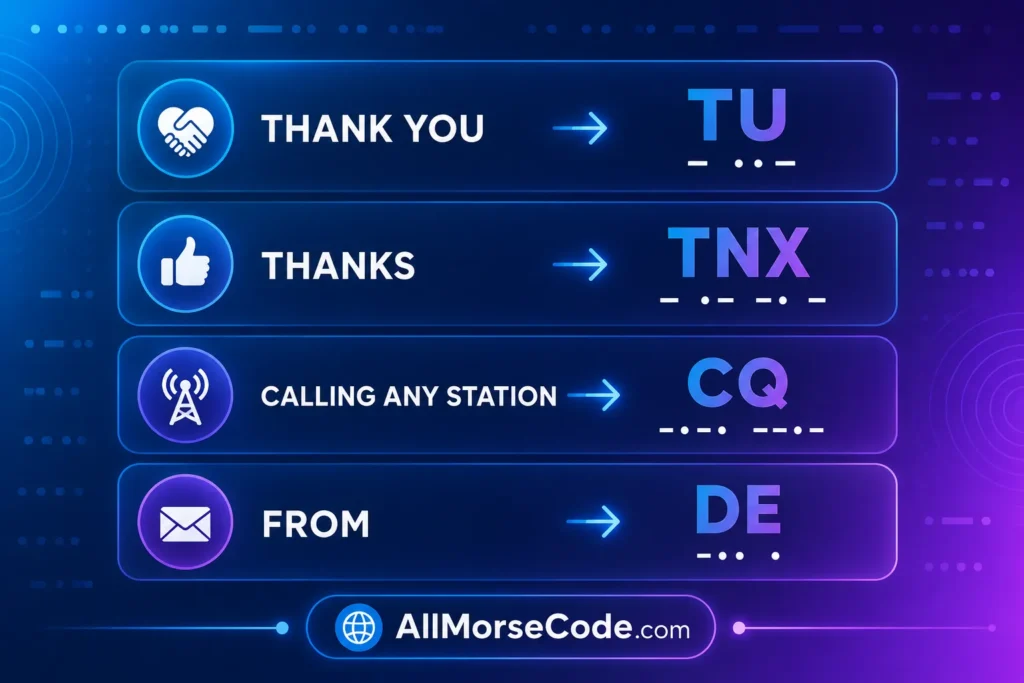
For example, instead of “thank you,” operators send TU or TNX. Instead of “calling any station,” they send CQ. These became standard because they save time while remaining instantly recognizable to experienced operators.
Although most associated with amateur radio today, these abbreviations originated in the telegraph era, when operators handled hundreds of messages a day and every character mattered. Many survived the transition from commercial telegraphy to amateur radio because they proved reliable and universally understood.
If you’re still learning the alphabet, don’t try to memorize hundreds of abbreviations at once start with the common ones below and build from there. Listening to real transmissions with our Morse Code Audio Translator is one of the fastest ways to recognize abbreviations by sound instead of decoding each letter.
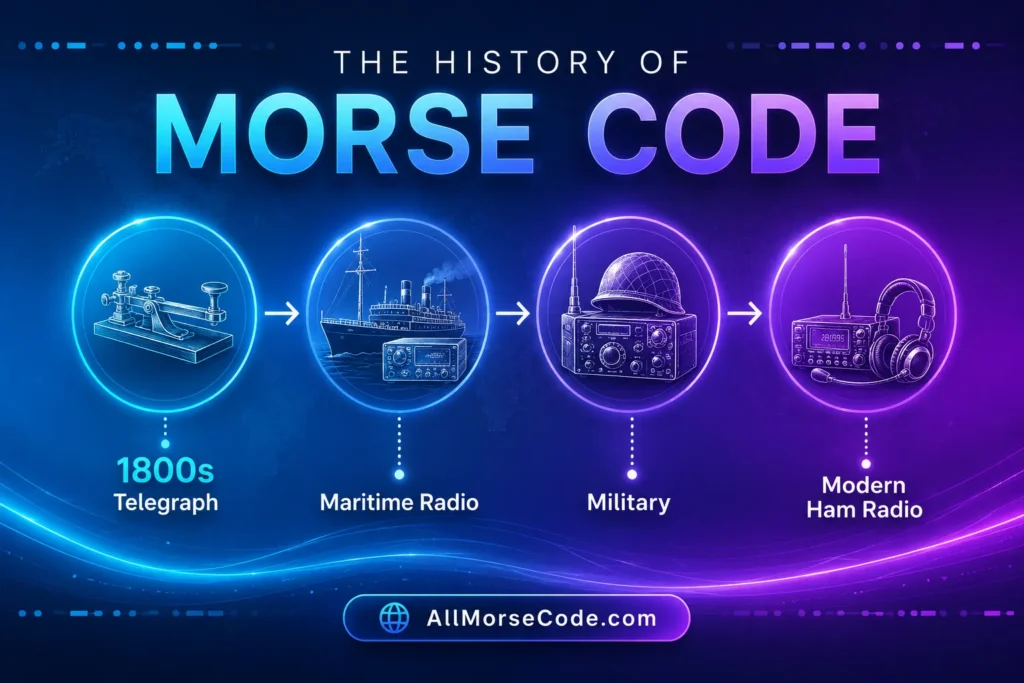
Telegraph networks relied on Morse code to send messages one character at a time, so shortening frequently used phrases became a practical way to save time and effort. As telegraph systems expanded through the 19th century, abbreviations became standard practice — railroad dispatchers used them to coordinate trains, commercial telegraph companies processed thousands of daily messages with them, and maritime operators relied on them for efficient exchanges.
The importance of standardized communication became especially clear during emergencies. The Titanic disaster is one of the best-known examples, where wireless operators’ distress transmissions exposed both the strengths and limits of early radio communication and helped shape operating conventions still used today. You can read more in our piece on the Titanic’s Morse code distress messages.
As radio replaced wired telegraph systems, amateur operators adopted the same abbreviations because they worked just as well over the air — CQ instead of “calling any station,” TNX instead of “thank you” — cutting transmission time while keeping conversations smooth, especially under weak signal conditions.
Why operators still use them today:
Did you know? Several Morse code abbreviations predate amateur radio itself, originating in commercial telegraphy in the late 1800s — over a century of continuous use.
CW stands for Continuous Wave — communicating in Morse code by switching a radio carrier on and off to form dots and dashes. Because every character adds transmission time, CW operators lean on abbreviations far more heavily than voice operators do; sending TNX instead of “THANK YOU” is a real time saving at any speed.
This is also why CW abbreviations remain popular: they cut airtime, improve readability for experienced ears, reduce copying errors on weak signals, speed up high-pressure contest exchanges, and function as a shared operating language across countries regardless of native tongue.
For the abbreviation set used in typical CW exchanges, refer back to the 25 Most Common Abbreviations table above — the same list applies whether you’re ragchewing or contesting. See full example conversations further down in Example CW Conversations.
You don’t need to memorize hundreds of abbreviations to follow real conversations — a relatively small set covers most beginner-level CW exchanges. This is the reference table the rest of this guide points back to.
Abbreviation | Meaning | Common Use |
|---|---|---|
CQ | Calling any station | General call inviting anyone to reply |
DE | From / This is | Identifies the transmitting station |
K | Go ahead | Invites the other station to transmit |
KN | Go ahead (named station only) | Limits the reply to one specific station |
R | Received | Confirms the message was copied |
RR | Message received completely | Strong acknowledgment |
TNX | Thanks | Expresses appreciation |
TU | Thank you | Short acknowledgment |
PSE | Please | Makes a polite request |
OM | Old Man | Friendly term for a male operator |
YL | Young Lady | Female amateur radio operator |
XYL | Wife | Refers to an operator’s wife |
ES | And | Replaces “and” |
FER | For | Shortens “for” |
AGN | Again | Requests repetition |
BK | Break | Short pause during a conversation |
AR | End of message | Message is complete |
SK | End of contact | Communication has ended |
AS | Wait | Asks the other station to pause |
BT | Break between thoughts | Separates ideas within a message |
FB | Fine Business | Means excellent |
WX | Weather | Current weather conditions |
HR | Here | Indicates location |
73 | Best regards | Friendly closing |
88 | Love and kisses | Warm sign-off, traditionally to a YL |
Once these feel natural, Q-codes and prosigns (covered below) will be much easier to pick up. For practice with full messages rather than isolated terms, try Hello in Morse code, Hi in Morse code, or Goodbye in Morse code.
A fuller reference for when you need something beyond the top 25. You don’t need to memorize all of it — bookmark it instead.
Abbreviation | Meaning | Category |
|---|---|---|
AA | All after | Operating |
AB | All before | Operating |
ABT | About | General |
ADS | Address | General |
AGN | Again | Operating |
ANS | Answer | General |
AR | End of message | Prosign |
AS | Wait | Prosign |
BK | Break | Prosign |
BT | Break / new paragraph | Prosign |
C | Correct | Operating |
CFM | Confirm | General |
CL | Closing station | Operating |
CQ | Calling any station | Calling |
CUL | See you later | General |
CUAGN | See you again | General |
DE | From / This is | Calling |
DR | Dear | General |
ES | And | General |
FER | For | General |
FB | Fine Business | Ham Radio |
GA | Good Afternoon | General |
GE | Good Evening | General |
GM | Good Morning | General |
GN | Good Night | General |
GUD | Good | General |
HR | Here | General |
HV | Have | General |
HW | How | General |
K | Go ahead | Calling |
KN | Go ahead (named station only) | Calling |
MSG | Message | Operating |
NIL | Nothing | Operating |
NR | Number | Operating |
OM | Old Man | Ham Radio |
OP | Operator | General |
PSE | Please | General |
R | Received | Operating |
RPT | Repeat | Operating |
RX | Receive | Technical |
SK | End of contact | Prosign |
SN | Soon | General |
SOS | Distress signal | Emergency |
TKS | Thanks | General |
TNX | Thanks | General |
TU | Thank you | General |
TX | Transmit | Technical |
UR | Your / You’re | General |
VY | Very | General |
WX | Weather | General |
XCVR | Transceiver | Technical |
XYL | Wife | Ham Radio |
YL | Young Lady | Ham Radio |
73 | Best Regards | Number Code |
88 | Love and Kisses | Number Code |
Terms like CQ, DE, R, K, TNX, 73, and PSE appear constantly; others are more common in message handling, emergency traffic, or formal procedure. Try entering any of these into our Morse Code Audio Translator to hear how they sound as CW signals.
Grouping by use case makes a long list easier to learn — most operators get familiar with the subset they actually use rather than the whole alphabet at once.
Everyday abbreviations: CQ, DE, K, R, TNX, TU, PSE, UR, WX, HR, 73 — the terms you’ll hear in nearly every casual CW conversation.
Ham radio / conversational abbreviations: OM, YL, XYL, FB, ES, FER, AGN, CUL, CUAGN common during relaxed conversations (“ragchews”) about equipment, weather, or daily life.
Emergency abbreviations: SOS, AS, BK, AR — rare in use but essential to recognize. For the history and meaning behind the most important one, see our guide to SOS in Morse code.
Telegraph-era abbreviations: ABT (About), CFM (Confirm), MSG (Message), NR (Number), NIL (Nothing received) — these let telegraph operators process high volumes of traffic with minimal transmission time, and several are still used in amateur radio today.
Q-codes are standardized three-letter codes that always begin with Q. Unlike abbreviations (which shorten ordinary words), Q-codes were developed for commercial radiotelegraph service specifically to overcome language barriers between operators from different countries — a single Q-code conveys information a full sentence would otherwise take much longer to send.
For example: instead of “What is your location?” an operator sends QTH?; instead of “I am experiencing interference,” they send QRM.
Most common Q-codes:
Q-Code | Meaning | Example Use |
|---|---|---|
QTH | My location is… | Sharing your city or location |
QSL | I acknowledge receipt | Confirming a message or contact |
QRM | Man-made interference | Reporting interference from other stations |
QRN | Natural interference | Static from lightning or atmospheric noise |
QRZ | Who is calling me? | Asking which station called |
QSY | Change frequency | Moving to another frequency |
QRT | Stop transmitting | Ending transmission |
QRX | Please wait | Asking another station to stand by |
QSB | Signal fading | Reporting fading signal strength |
QSO | Radio contact | Refers to a conversation between stations |
QRP | Low-power operation | Operating with reduced transmitter power |
QRO | Increase transmitter power | Raising output power |
QRL | Is this frequency in use? | Checking before transmitting |
QRS | Send more slowly | Asking an operator to reduce speed |
QRQ | Send faster | Requesting a higher transmission speed |
Q-codes vs. abbreviations:
Morse Code Abbreviations | Q-Codes |
|---|---|
Shortened words or phrases | Standardized operating codes |
Examples: TNX, PSE, OM, YL | Examples: QTH, QSL, QRM |
Mostly conversational | Operational and technical |
Developed by telegraph operators | Developed for international radiotelegraph service |
Put simply: abbreviations make conversations shorter; Q-codes make communication clearer across languages. Most operators use both in a single contact.
Learning order for beginners: QTH → QSL → QRZ → QRM → QRN → QSY → QSO → QRP → QRL → QRS. Once these feel familiar, you’ll naturally pick up additional Q-codes as your operating experience grows.
Practice tip: enter QTH, QSL, or QRM into the Morse Code Audio Translator to learn their rhythm by ear, or use the Morse Code Image Translator to connect written text with the code before jumping into live conversations.
Prosigns and abbreviations are easy to confuse because both show up constantly in CW conversations, but they do different jobs. An abbreviation replaces a word or phrase — TNX means “thanks,” OM refers to a male operator. A prosign is a procedural signal that controls the flow of the conversation — it doesn’t replace a word, it tells the other operator what’s happening next (message complete, please wait, your turn).
The simplest way to remember it: abbreviations tell you what someone is saying; prosigns tell you how the conversation should continue. Prosigns are also sent as continuous characters without a normal letter-spacing gap, marking them as procedural rather than conversational.
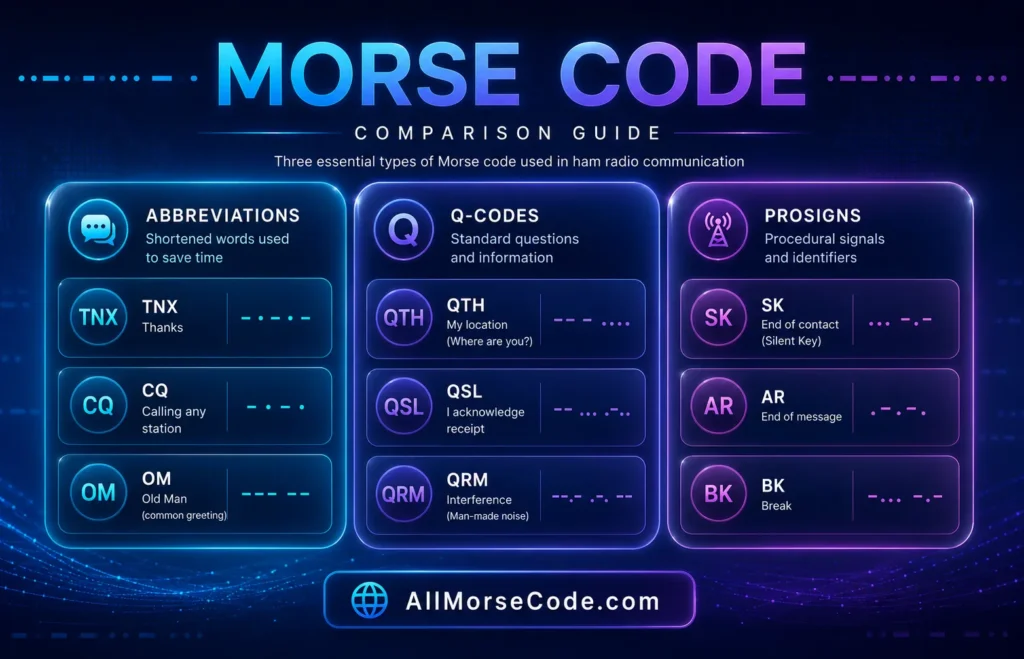
Type | Purpose | Examples |
|---|---|---|
Abbreviation | Shortens words | TNX, OM, WX, ES, FER |
Q-Code | Standard operating code | QTH, QRM, QSL |
Prosign | Controls communication flow | SK, AR, BK, BT, AS |
Number Code | Common closing expressions | 73, 88 |
Common prosigns:
Prosign | Meaning | When It’s Used |
|---|---|---|
AR | End of message | Message complete, but contact may continue |
SK | End of contact | Signals the conversation has ended |
BK | Break | Hands the conversation back without using call signs |
BT | Break / new paragraph | Separates ideas within a message |
AS | Wait | Asks the other operator to pause |
KN | Go ahead (specific station) | Invites only one station to reply |
KA | Beginning of formal message | Common in message handling / traffic nets |
For a worked example showing abbreviations and prosigns used together in one exchange, see Example CW Conversations below. To learn prosigns efficiently: start with SK, AR, and BK since they appear in nearly every contact, and practice hearing them (not just reading them) with the Morse Code Audio Translator.
Not every Morse shortcut is made of letters — 73 and 88 are the best-known number codes in amateur radio, carrying specific meanings passed down from the early telegraph era.
73 means “Best regards.” It’s the standard, polite way to end a Morse code or amateur radio conversation — equivalent to “take care” or “have a great day.” You’ll hear it at the close of nearly every QSO.
Example: TNX FER QSO / 73 SK → “Thanks for the conversation. Best regards. End of contact.”
88 traditionally means “Love and kisses.” Historically sent as a warm closing to a YL or a close personal friend. It’s used far less often than 73 today, but still appears in friendly or personal exchanges.
Example: 73 88 / SK → “Best regards and love. End of contact.”
Other number codes (less common today, but you may see them in older manuals or from experienced operators):
Number Code | Meaning | Modern Usage |
|---|---|---|
55 | Good luck and success | Occasional |
72 | Best regards (QRP operators) | Common among low-power operators |
77 | Long-distance friendship | Rare |
99 | Go away / conversation ended | Rare, informal |
Where these came from: Telegraph companies introduced number codes in the mid-1800s to speed up high-volume daily message traffic and reduce operator workload. Several commercial telegraph companies, including Western Union, developed standardized numerical codes for this purpose; as radio communication evolved, the most practical ones — especially 73 and 88 — carried over into amateur radio and have stayed in use ever since.
When to use which: Use 73 when ending a QSO, signing off after helping another operator, finishing a contest exchange, or closing written correspondence with another amateur. Use 88 with a close friend, when sending greetings to a YL, or in a personal/informal conversation. If you’re unsure, 73 is always the safer choice.
Common mistakes: Adding an “s” to 73 (“73s”) is redundant, since 73 already means “best regards” — plain 73 is preferred. Using 88 in every contact is also a mismatch, since it carries a more personal tone than most first-time or contest exchanges call for. And it’s worth keeping the categories straight: 73 is a number code, QTH is a Q-code, TNX is an abbreviation, and SK is a prosign — each does a different job.
Abbreviations, Q-codes, prosigns, and number codes all come together in real exchanges. Most casual CW contacts follow the same basic shape: call → reply → acknowledge → exchange signal report/location/weather → close politely.
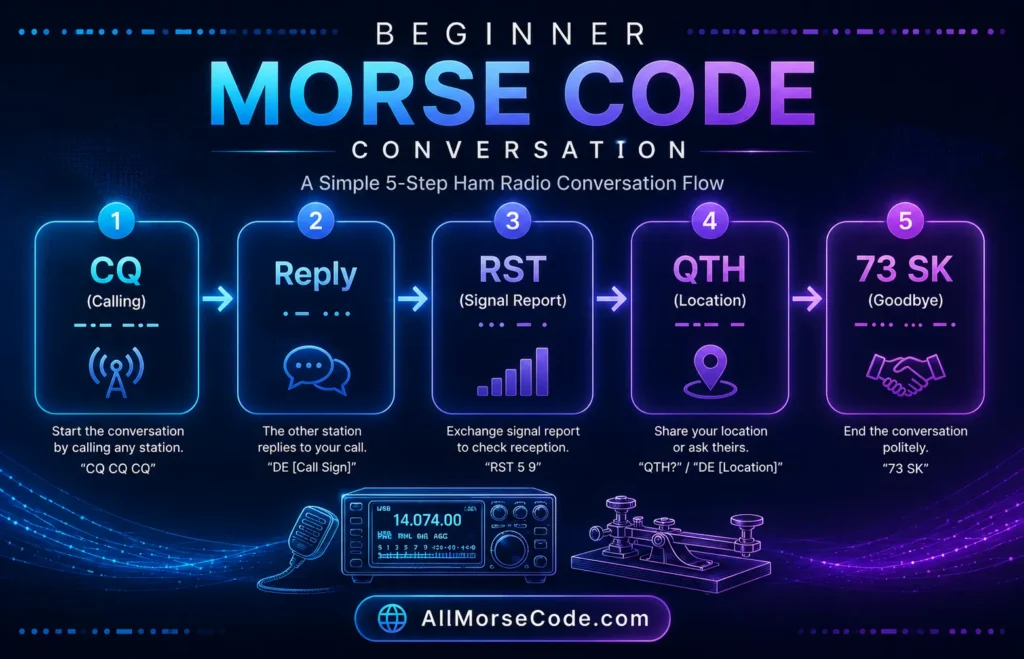
Beginner contact:
Morse | Meaning |
|---|---|
CQ CQ CQ DE W1ABC K | Calling any station. This is W1ABC. Go ahead. |
W1ABC DE K9XYZ KN | W1ABC, this is K9XYZ. Reply only to me. |
R R TNX FER CALL | Copied your message. Thanks for calling. |
UR RST 599 | Your signal report is 599 (excellent). |
QTH CHICAGO IL | My location is Chicago, Illinois. |
WX HR SUNNY 28C | Weather here is sunny, 28°C. |
RIG 100W DIPOLE | I’m running 100 watts on a dipole antenna. |
FB OM | Excellent, my friend. |
73 SK | Best regards. End of contact. |
Contest-style exchange
(speed matters — only essentials are sent, often complete in under 15 seconds):
Weak-signal exchange
(shows why Q-codes and abbreviations matter most under poor conditions):
Common CW exchange pattern, for reference:
Stage | Typical Signals |
|---|---|
Calling | CQ, DE, K |
Reply | DE, KN |
Acknowledgment | R, RR, TNX |
Signal Report | RST |
Location | QTH |
Weather | WX |
Equipment | RIG, ANT |
Closing | 73, SK |
Try copying the beginner example into the Morse Code Translator and listening at different speeds — you’ll start recognizing abbreviations by rhythm rather than decoding letter by letter. You can also build your own practice messages with Hello in Morse code, Good Morning in Morse code, or Yes and No in Morse code.
Trying to memorize hundreds of abbreviations at once. Most everyday CW conversations rely on a small vocabulary — start with CQ, DE, K, R, TNX, TU, PSE, OM, WX, and 73, then add Q-codes and prosigns gradually.
Confusing abbreviations, Q-codes, prosigns, and number codes. TNX is an abbreviation, QTH is a Q-code, SK is a prosign, and 73 is a number code — each plays a different role.
Focusing only on reading, not listening. Experienced operators recognize sound patterns, not individual letters. Regular listening practice (via the Audio Translator) trains this skill far faster than reading lists.
Practicing terms in isolation instead of in context. Learning CQ DE W1ABC K / TNX FER CALL / WX HR SUNNY / 73 SK as a whole message sticks better than memorizing each term separately.
Skipping regular practice. Ten minutes a day beats one long weekly session. Reinforce it with short, familiar phrases like Goodbye in Morse code, Happy Birthday in Morse code, or I Love You in Morse code.
Experience Level | What to Learn |
|---|---|
Beginner | Morse alphabet, CQ, DE, K, 73 |
Intermediate | 25 common abbreviations, QTH, QSL, QRZ |
Advanced | Full A–Z list, contest exchanges, DX abbreviations, CW operating |
A one-page cheat sheet is useful to keep beside your radio, desk, or notebook so you’re not searching online mid-practice. A good reference sheet covers the 25 most common abbreviations, the full A–Z list, common Q-codes, frequent prosigns, number codes (73/88), and a quick alphabet reference — all the tables above, condensed onto one page.
How to use it effectively:
- Learn five new abbreviations a day.
- Listen to them via the Morse Code Audio Translator.
- Write each one by hand a few times.
- Practice sending them with a straight key or paddle.
- Review older terms before adding new ones.
As you progress, consider building a personal condensed version with just your most-used abbreviations, favorite Q-codes, common prosigns, and typical contest exchanges — many experienced operators keep one taped near their station.
Morse code abbreviations have stood the test of time because they make communication faster, clearer, and more efficient from early commercial telegraphy through to modern amateur radio. Focus first on the most common abbreviations, then layer in Q-codes, prosigns, and number codes as you get comfortable. Practice them inside real messages rather than as isolated definitions, listen to actual CW exchanges, and use the Morse Code Audio decoder and Morse Code Image Translator regularly — that combination will get you from recognizing individual terms to following real conversations naturally.

Steve Johnson
Founder of AllMorseCode.com and creator of educational Morse code resources used by learners worldwide. Specializes in Morse code translation, signal encoding concepts, communication history, and practical learning methods. Publishes in-depth guides, reference materials, and interactive tools that make Morse code simple, accurate, and accessible for students, amateur radio enthusiasts, emergency preparedness learners, and everyday users.