Happy Birthday in Morse Code + Audio & Letter Chart
Writing Happy Birthday in Morse Code is a fun way to turn a simple greeting into a hidden message. Whether you’re creating a personalized birthday card, engraving jewelry, designing a custom gift, or simply sending a unique text, Morse code adds a memorable touch that stands out from ordinary birthday wishes.
On this page, you’ll find the correct Morse code translation, an easy copy-and-paste version, a letter-by-letter breakdown, and step-by-step instructions on how to read and write the phrase. If you’re completely new to Morse code, it’s worth spending a few minutes learning the Morse code alphabet first, as it makes understanding greetings and other messages much easie
Happy Birthday in International Morse Code is:
…. .- .–. .–. -.– / -… .. .-. – …. -.. .- -.–

Item | Value |
|---|---|
Phrase | Happy Birthday |
Morse Code | …. .- .–. .–. -.– / -… .. .-. – …. -.. .- -.– |
Standard | International Morse Code |
Difficulty | Beginner |
Best Uses | Cards, Gifts, Messages |
The forward slash / separates words in written Morse code. Real Morse transmissions use timing instead of slashes, but the slash is the most common way to show a space when Morse code is written as text.
If you’d like to understand why dots, dashes, and spacing work this way, check out our complete Morse code guide, where you’ll learn the basics of encoding and decoding messages.
Did you know? Morse code doesn’t actually use “/” during transmission it’s simply a written separator to make text easier to read. Actual Morse code uses timing and pauses between words.
[ez-toc]
The phrase translates to “Happy Birthday.” Each letter is converted into a unique combination of dots (.) and dashes (-) based on the International Morse Code alphabet — a system used for more than a century in telegraphy, amateur radio, emergency signaling, and educational activities.
Although Morse code is no longer used for everyday communication, it’s still popular for personalized gifts, greeting cards, escape room puzzles, and creative messages because it turns ordinary words into hidden codes.
Standard Morse Code
…. .- .–. .–. -.– / -… .. .-. – …. -.. .- -.–
Unicode Style
•••• •− •−−• •−−• −•−− / −••• •• •−• − •••• −•• •− −•−−
Some websites and messaging apps may not display Unicode symbols correctly. If that happens, use the standard dot-and-dash version above. Stick to one style per message — mixing standard and Unicode symbols in the same message makes it harder to read.
Where You Can Use It
- Birthday cards
- Text messages, WhatsApp, Facebook, Instagram captions
- Gift tags and personalized jewelry
- Cake toppers and custom mugs
- Digital invitations
If you’d like to turn the text into a shareable graphic, try the Morse Code Image Translator useful for printable birthday cards, posters, or social media graphics featuring your hidden message.
Rather than memorizing the whole phrase at once, it’s easier to convert one letter at a time using the Morse alphabet, then string the results together.
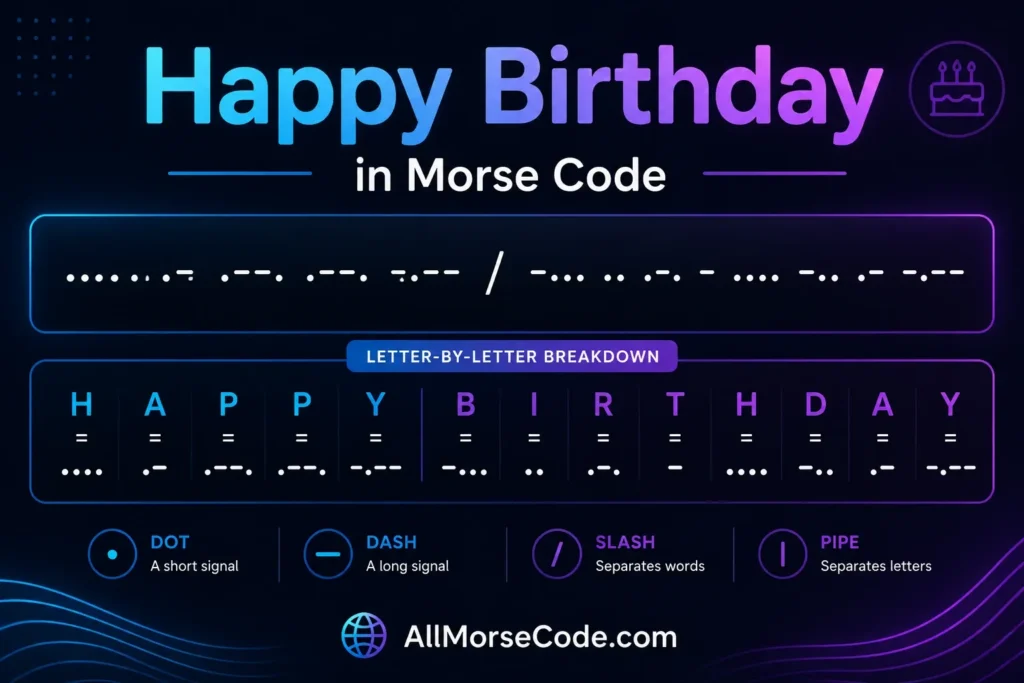
Letter | Morse Code |
|---|---|
H | …. |
A | .- |
P | .–. |
P | .–. |
Y | -.– |
(space) | / |
B | -… |
I | .. |
R | .-. |
T | – |
H | …. |
D | -.. |
A | .- |
Y | -.– |
Putting these together gives you the full phrase:
…. .- .–. .–. -.– / -… .. .-. – …. -.. .- -.–
Quick memory tricks for the first few letters:
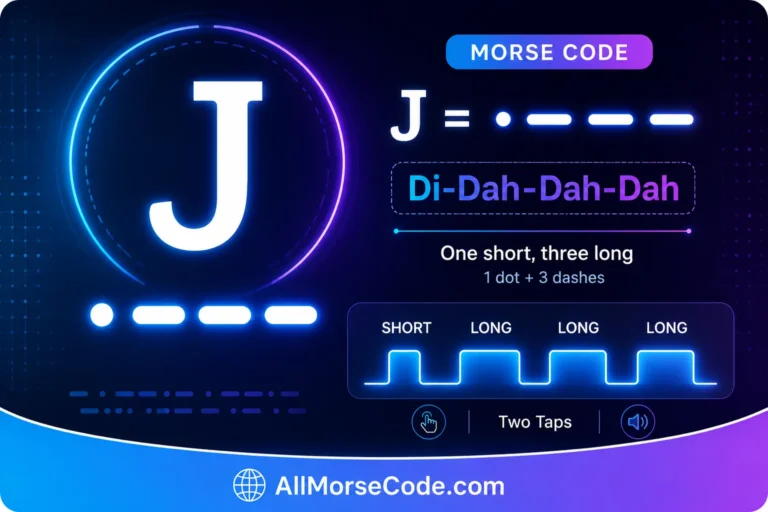
- H — four dots, easy to spot: ….
- A — one dot, one dash: .-
- P — dot, dash, dash, dot: .–.
- Y — dash, dot, dash, dash: -.–
- B — one dash followed by three dots: -…
Once you recognize these patterns, decoding or writing other greetings gets much faster. If you’re still learning the alphabet, the complete Morse code alphabet guide covers every letter, number, and punctuation mark with examples.
Word Separation, Explained
In written Morse code, spacing does three different jobs:
- Small spaces between symbols form a letter
- Larger spaces separate letters
- Even larger pauses separate words
Since text can’t display timing naturally, a forward slash (/) is the standard way to show a word break. This is one of the most common things beginners get wrong, so it’s worth double-checking before you print or engrave a message.
Instead of speaking letters, Morse code uses short and long signals:
- Dot (·) = a short signal, often called a “dit”
- Dash (–) = a long signal, often called a “dah”
Signal | Length |
|---|---|
Dot | 1 unit |
Dash | 3 units |
Letter gap | 3 units |
Word gap | 7 units |
When transmitting the phrase: read one signal at a time, pause briefly between letters, and pause a little longer between “Happy” and “Birthday.” For example, H (….) is four short signals in a row, while A (.-) is one short signal followed by one long one.
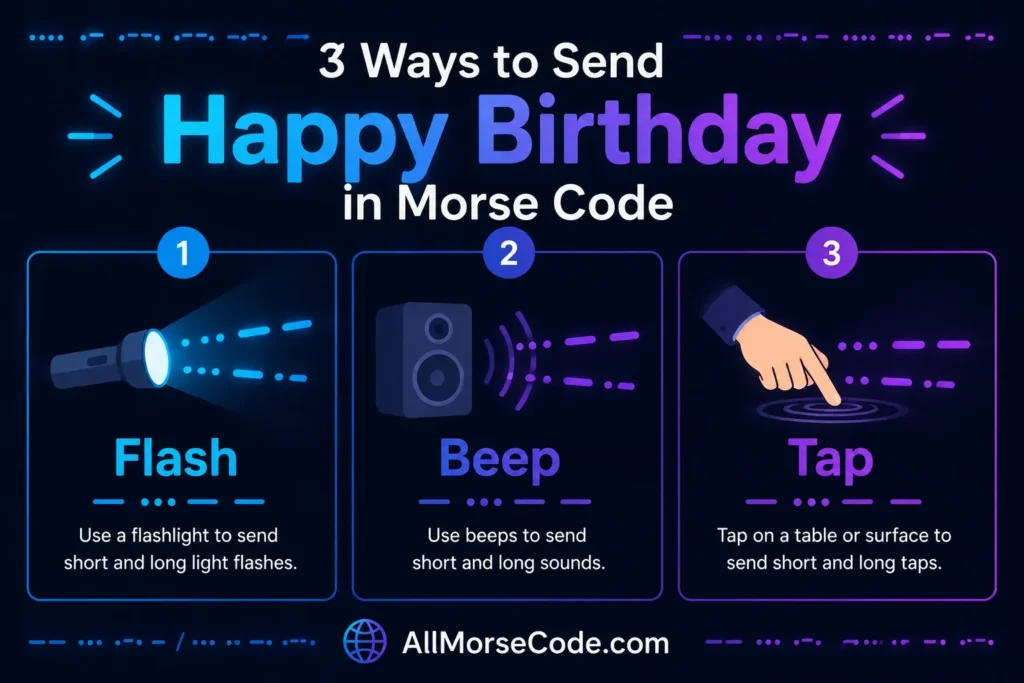
Three low-tech ways to actually send it:
- Flashlight — a quick flash for a dot, a longer hold for a dash. Great for camping trips, outdoor parties, or nighttime celebrations.
- Sound — short beeps for dots, long beeps for dashes.
- Tapping — a short tap for a dot, a longer tap for a dash. A common way beginners practice timing and rhythm.
Many people find it easier to learn by ear rather than by reading symbols. You can hear how the phrase sounds using the best Morse Code Audio decoder, which converts written Morse code into audio matching standard timing reinforcing rhythm, spacing, and character recognition all at once.
A Morse code message feels more personal because it invites the recipient to decode it rather than just read it — which is exactly why it’s become a favorite for birthdays, anniversaries, and other special occasions.
Cards
- Minimalist: Morse code on the front, plain English translation inside (“Happy Birthday! Here’s your secret message in Morse code.”)
- Puzzle card: Don’t reveal the translation — challenge the recipient to decode it themselves, with a small hint like “Need help? Use a Morse code chart.”
- Printable/poster: Convert the phrase into a polished visual with the Morse Code Image Translator for framed wall art, gift tags, or party decorations.
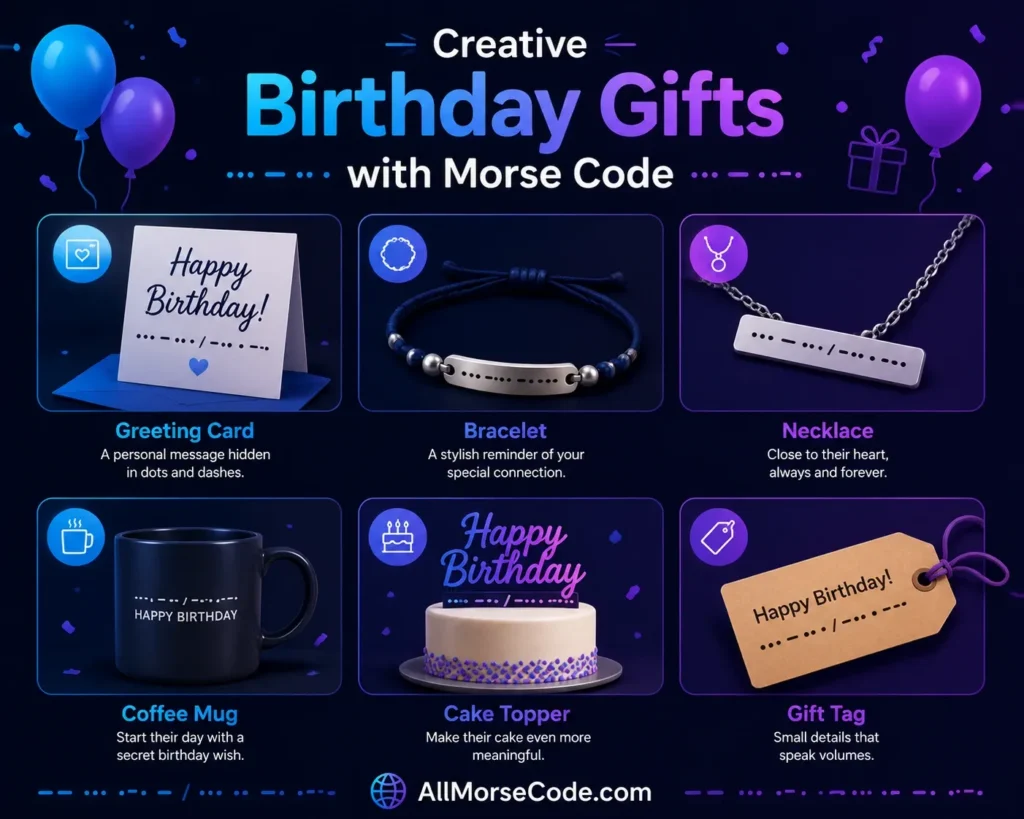
Jewelry and keepsakes — bracelets, necklaces, rings, keychains, watches, and wallets are all popular for engraving. Many people pair the birthday message with I Love You in Morse Code for a spouse, partner, or family member.
Party decorations — cake toppers, balloons, banners, welcome signs, table centerpieces, and cupcake wrappers all work well as a fun decoding activity for guests. For cakes specifically, the pattern of dots and dashes translates cleanly into icing dots, fondant shapes, chocolate decorations, or edible printed toppers run it through the Free Morse Code Image Translator first so your cake decorator gets the spacing exactly right.
Digital wishes — Morse code is short and clean, so it works well in WhatsApp messages, Instagram captions, Facebook posts, birthday emails, and digital invitations. Turn it into a graphic with the Morse Code Image Translator for a more polished look than plain text.
Hidden treasure hunt — planning a surprise? Hide Morse code clues around the house or party venue and let the birthday person decode each one before finding their gift. For younger or beginner decoders, mix in short, familiar phrases like Hello, Yes, or No in Morse Code alongside the birthday message.
Once you’ve got this phrase down, build on it with other common greetings — recognizing patterns across several short phrases is much faster than memorizing the alphabet in isolation. Good next phrases:
Whether you’re creating a personalized birthday card, engraving a meaningful gift, or just looking for a creative way to wish someone well, Happy Birthday in Morse Code adds a unique, memorable touch. Once you’ve learned this phrase, plenty of other everyday greetings become just as easy to write and decode keep practicing with different words, experiment with the audio and image translators, and explore the related Morse code resources across AllMorseCode to keep building your skills one message at a time.