Good Morning in Morse Code (Translation, Meaning & How to Send)
Have you ever wanted to greet someone using Morse code or wondered how to say good morning in Morse code? Whether you’re learning Morse code as a hobby, practicing for amateur radio, teaching students, or simply curious about secret communication methods, familiar phrases like “Good Morning” are an excellent place to start. They help you recognize common letter patterns while improving your timing and accuracy.
In this guide, you’ll learn the complete Morse code translation for Good Morning, its letter-by-letter breakdown, how to send it using sound or light signals, and the correct spacing rules. If you’re new to Morse code, it’s also helpful to learn the Morse code alphabet first, as understanding individual letters makes reading and sending complete phrases much easier.
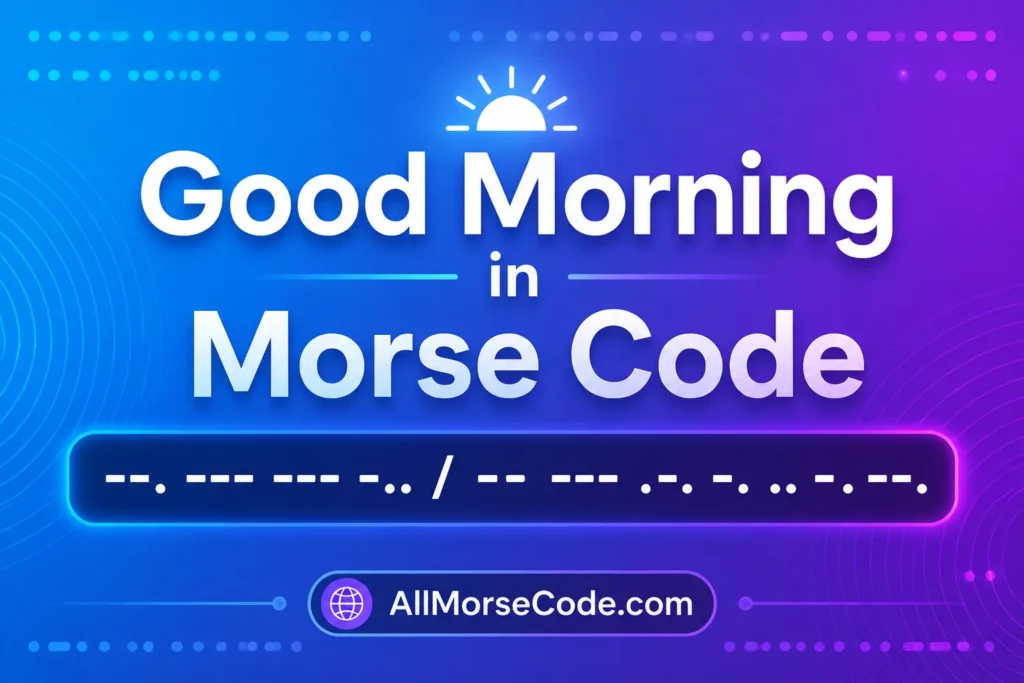
Good Morning in Morse Code
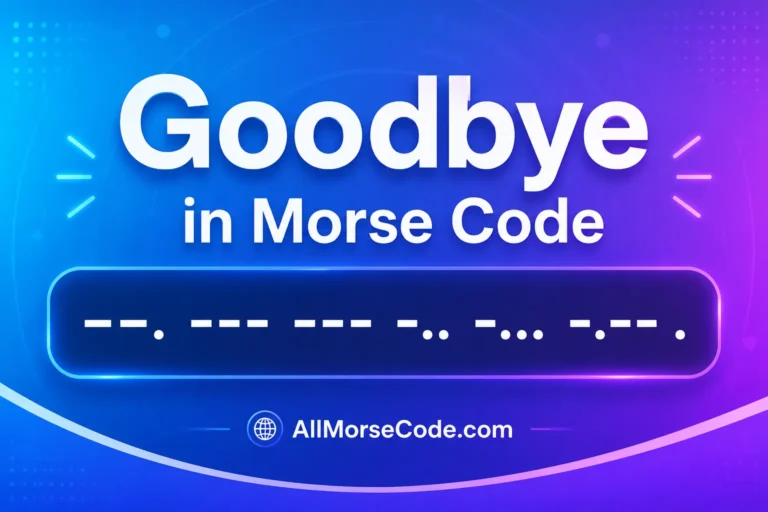
–. — — -.. / — — .-. -. .. -. –.
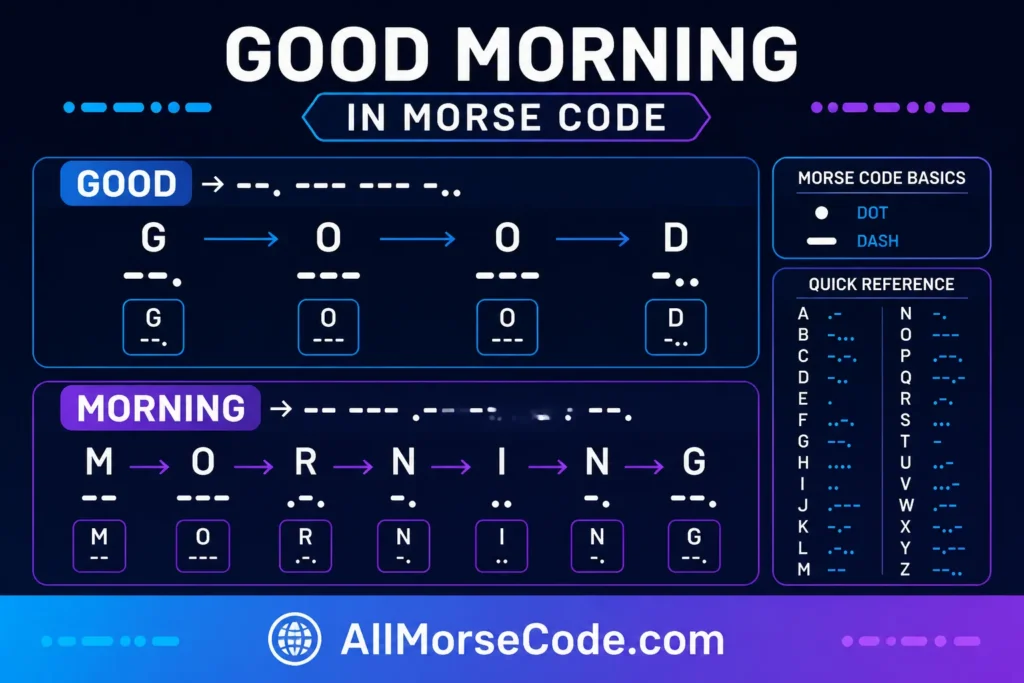
GOOD MORNING
G O O D
–. — — -..
M O R N I N G
— — .-. -. .. -. –.
“Good Morning” in Morse code uses the International Morse Code standard. Each letter is represented by a unique sequence of dots and dashes, with a short pause between letters and a longer pause between words.
[ez-toc]
Good Morning in Morse code is a friendly greeting written using the International Morse Code standard. Every letter is represented by a unique combination of dots (·) and dashes (–), making it possible to communicate through sound, light, radio signals, or even hand taps.
Unlike emergency signals such as SOS in Morse code , this phrase is used for everyday communication, Morse code practice, educational activities, and amateur radio conversations.
If you’re learning common greetings, “Good Morning” is one of the best phrases to practice because it combines both simple and slightly more advanced Morse code characters.
Good Morning vs. SOS in Morse Code
Although both use the same Morse code system, Good Morning and SOS serve completely different purposes.
Good Morning | SOS
Friendly greeting | International distress signal
Used in everyday communication | Used only during emergencies
Ideal for practice and learning | Used to request immediate assistance
Common in amateur radio conversations | Recognized worldwide for emergency communication
Because SOS in Morse code is reserved for emergencies, it should never be used as a joke or for casual conversations. “Good Morning,” on the other hand, is simply a polite greeting that helps learners practice Morse code in realistic situations.
Letter-by-Letter Morse Code Breakdown
Breaking the phrase into individual letters makes it much easier to learn and memorize.
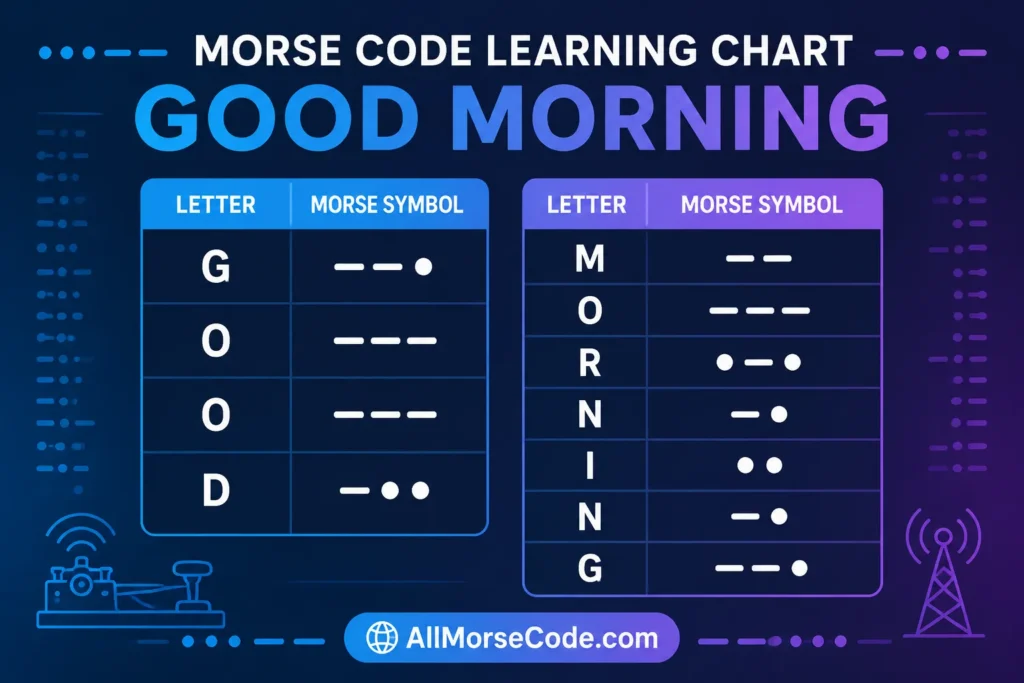
Letter | Morse Code | How It Sounds
G | –. | dah-dah-dit
O | — | dah-dah-dah
O | — | dah-dah-dah
D | -.. | dah-dit-dit
M | — | dah-dah
O | — | dah-dah-dah
R | .-. | dit-dah-dit
N | -. | dah-dit
I | .. | dit-dit
N | -. | dah-dit
G | –. | dah-dah-dit
Practicing one letter at a time helps you build muscle memory and recognize common Morse code patterns more quickly. Saying the phonetic sounds out loud — “dah-dah-dit, dah-dah-dah…” — while you read the pattern is one of the fastest ways to internalize rhythm before you ever touch a key or light. Once you’re comfortable with individual letters, try combining them into complete words without looking at the chart.
If you’d like to expand your vocabulary after mastering this phrase, explore more common Morse code words to practice additional everyday expressions.
There are several practical ways to transmit this greeting, and each suits a different situation.
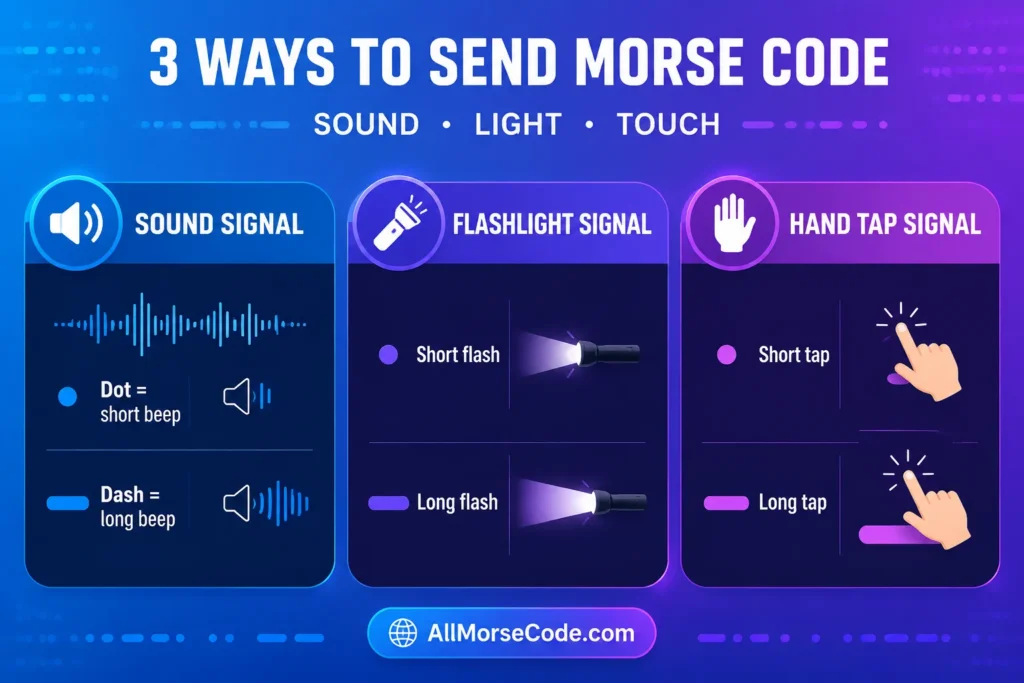
Send With Sound
Send a short beep for a dot and a beep three times longer for a dash. This is the standard method used in amateur radio and is worth mastering first, since most other formats (tapping, blinking) are really just this same rhythm translated into a different medium. Listening to the phrase with our Morse code audio translator helps you internalize the rhythm before sending it yourself.
Send With Flashlight or Blink Signals
A short flash or blink is a dot; a longer one is a dash. This visual version of the same G-O-O-D / M-O-R-N-I-N-G pattern is commonly used in scouting, outdoor activities, and emergency preparedness training where sound isn’t practical.
Send With Hand Taps
No equipment? Tap the same pattern on a table — a quick tap for a dot, a slightly longer tap for a dash. It’s a simple way to drill the phrase’s rhythm anywhere, without needing to be near a light or speaker.
Morse Code Timing Rules
One of the biggest mistakes beginners make is focusing only on dots and dashes while ignoring timing. In Morse code, spacing is just as important as the symbols themselves. Applied to “Good Morning,” a dash in the G at the start of “Good” should last three times as long as a dot, and the pause between “Good” and “Morning” should be noticeably longer than the pause between individual letters like M and O.
Signal | Duration
Dot (·) | 1 unit
Dash (–) | 3 units
Gap between symbols | 1 unit
Gap between letters | 3 units
Gap between words | 7 units
These timing rules are based on the International Morse Code standard and are widely used by amateur radio operators around the world. If you’re a visual learner, you can also view Morse patterns using our Morse code image translator which makes it easier to recognize signal sequences.
Real World Uses for Good Morning
Beyond radio practice, this phrase is one of the most popular Morse translations people search for because it works well outside a classroom or radio room:
Engraved jewelry or bracelets, where the dot-dash pattern is stamped or beaded as a subtle daily reminder.
Tattoos, since the phrase is short enough to fit cleanly as a wrist or finger tattoo.
Texting or messaging a partner as a quiet “thinking of you” each morning.
Amateur radio drills, where common greetings are used to warm up before real conversations.
Knowing the intended use also affects how precise you need to be with spacing — a tattoo or engraving is permanent, so double-check the sequence against the chart above before sending it anywhere for production.
Learning good morning in Morse code is fairly straightforward, but a few small mistakes can change how the message is understood.
Rushing Through the Message
Sending too quickly causes the dots and dashes in words like “Morning” to blend together. Start slowly and focus on a steady rhythm before increasing speed.
Ignoring Letter and Word Spacing
Without a clear pause between “Good” and “Morning,” the receiver may read it as one long, meaningless string of letters rather than two distinct words.
Mixing International and American Morse Code
Almost all modern resources, amateur radio operators, and communication systems use International Morse Code. Avoid learning American Morse unless you have a specific historical interest, as the two systems use different character patterns.
Memorizing Without Practice
Reading the symbols isn’t enough — practice listening to, sending, and decoding the phrase regularly. Try practicing “Good” and “Morning” as two separate short drills before combining them, and repeat daily rather than in one long session.
After learning Good Morning, you can continue improving your Morse code skills by practicing other everyday greetings and phrases. Since these expressions appear frequently in conversations, they help reinforce letter recognition and signal timing.
Phrase | Purpose
Hello in Morse code | Everyday, formal greeting
Hi in Morse code | Shorter, beginner-friendly greeting
Happy Birthday in Morse code | Longer phrase with varied letters
I Love You in Morse code | Personal messages
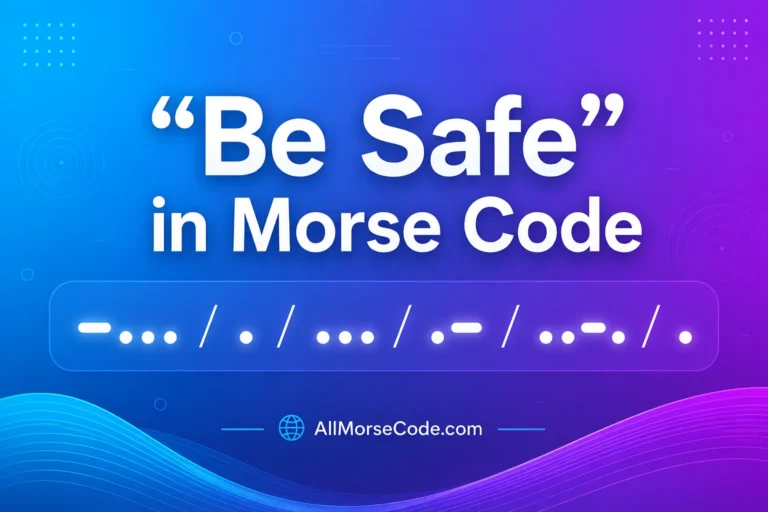
Be Safe in Morse code | Supportive, practical message
No in Morse Code | Help users quickly learn
Yes in Morse Code | Help users learn the Morse Code translation
I Miss you in Morse Code | Remember
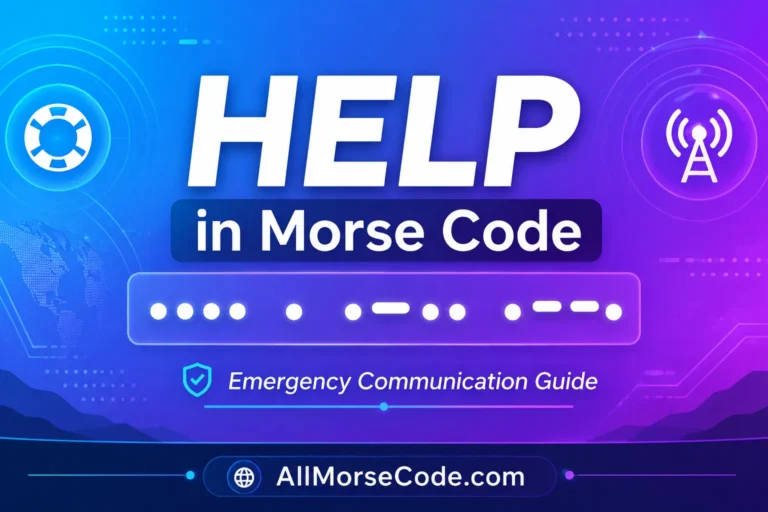
Help in Morse Code | Companaion
Learning related phrases one at a time is an effective way to expand your Morse code vocabulary while reinforcing the alphabet you’ve already learned.
Learning good morning in Morse code is a simple yet practical way to become more familiar with the International Morse Code system. By practicing the letter patterns, following proper timing rules, and understanding the difference between everyday greetings and emergency signals, you’ll build a strong foundation for learning more advanced words and phrases. As your confidence grows, continue practicing with other common greetings and everyday expressions to improve your speed, accuracy, and overall Morse code skills.

Steve Johnson
Founder of AllMorseCode.com and creator of educational Morse code resources used by learners worldwide. Specializes in Morse code translation, signal encoding concepts, communication history, and practical learning methods. Publishes in-depth guides, reference materials, and interactive tools that make Morse code simple, accurate, and accessible for students, amateur radio enthusiasts, emergency preparedness learners, and everyday users.