Morse Code Titanic: Complete Distress Messages,Transcript, CQD vs SOS Explained
When the RMS Titanic struck an iceberg on the night of April 14, 1912, its crew relied on the ship’s Marconi wireless telegraph to call for help. Senior wireless operator Jack Phillips and junior operator Harold Bride transmitted distress messages using Morse code, first sending CQD and later SOS as the emergency escalated. Those signals reached nearby ships, including the RMS Carpathia, whose arrival saved more than 700 people.
More than a century later, the Titanic’s wireless transmissions remain one of the best-known examples of Morse code in action. This guide explains how the ship sent its distress calls, why both CQD and SOS were used, what the surviving message transcripts reveal, and how the disaster changed maritime communication forever.
Quick Facts
[ez-toc]
The RMS Titanic used Morse code as its primary method of long-distance communication. Instead of voice radio, the ship relied on a Marconi wireless telegraph, which transmitted messages as short and long electrical signals known as dots and dashes. Every message was manually sent by a trained wireless operator using a telegraph key.
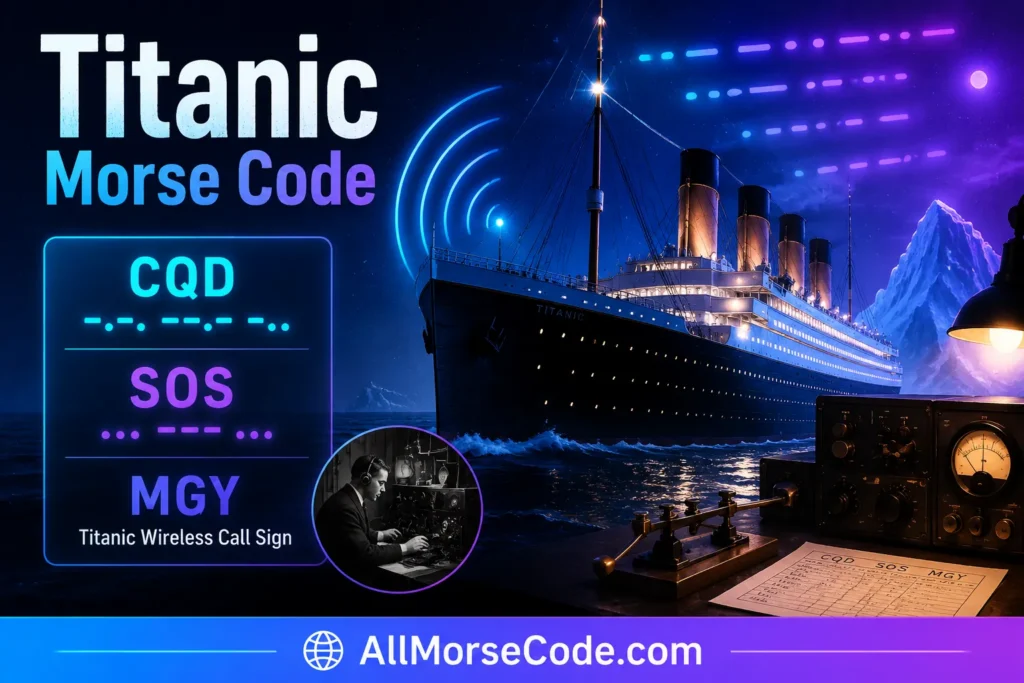
The ship’s radio call sign was MGY, allowing nearby ships and coastal stations to recognize its transmissions. During the voyage, the wireless room handled passenger telegrams, weather reports, navigation updates, and iceberg warnings. After the collision, it became the center of the rescue effort as operators continuously broadcast distress calls in the hope that another ship would respond.
If you’re unfamiliar with the communication system itself, our guide on what is Morse code explains how dots and dashes represent letters, numbers, and punctuation.
On board the RMS Titanic, Morse code was transmitted using a Marconi wireless telegraph system — one of the most advanced communication technologies available in 1912. Instead of sending messages through wires like a traditional telegraph, the system used radio waves generated by a spark-gap transmitter to send signals over long distances. This allowed the Titanic to communicate with nearby ships and coastal stations even while sailing in the middle of the North Atlantic.
Wireless operators sat in the ship’s radio room and used a telegraph key to tap out messages as combinations of dots and dashes. Incoming signals were received through headphones and written down by hand before being delivered to passengers or the ship’s officers.
You can hear how these signals would have sounded using the Morse Code Audio Translator, or see them represented visually with the Morse Code Image Translator.
Component | Purpose |
|---|---|
Telegraph key | Sent Morse signals |
Spark-gap transmitter | Generated radio waves |
Receiver | Picked up incoming messages |
Antenna | Sent and received signals |
Headphones | Allowed operators to hear transmissions |
The Titanic’s wireless room was located on the Boat Deck, close to the officers’ quarters, and consisted of two connected spaces: the operating room, where messages were transmitted and received, and the silent room, which housed the powerful wireless equipment. This arrangement helped reduce interference while allowing operators to work efficiently throughout the day and night.
The Marconi system wasn’t designed only for emergencies. Most of the time, operators handled passenger telegrams and exchanged routine messages with other ships and shore stations. After the collision, normal operations stopped, and the room became the center of the rescue effort as distress messages were sent almost continuously until electrical power failed.
If you’re interested in how skilled telegraphers could recognize entire words by sound instead of decoding each letter individually, read How Experienced Morse Code Operators Hear Words. It offers useful insight into the level of expertise required by operators like Phillips and Bride.
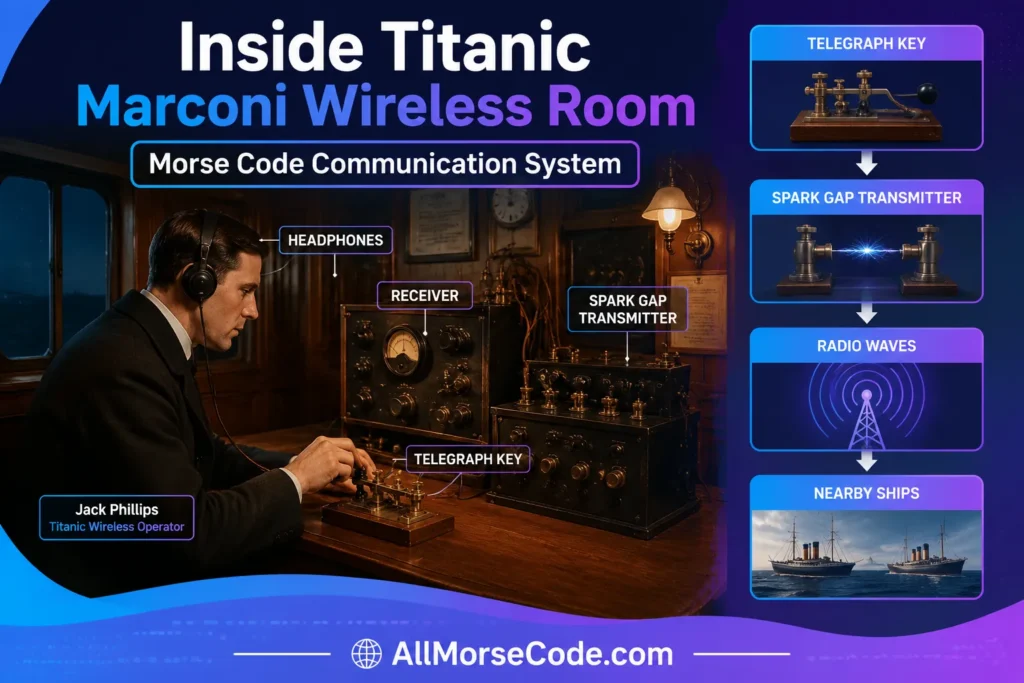
The Titanic’s wireless communications were managed by two trained Marconi employees: Jack Phillips, the senior wireless operator, and Harold Bride, the junior operator.
After the iceberg collision, both operators remained at their posts despite the increasing danger, transmitting distress calls and updating the ship’s position until the power failed. Phillips did not survive the sinking; Bride escaped on a collapsible lifeboat and later gave an account of the wireless room’s final hours to the New York Times — one of the few firsthand descriptions of what happened inside the room that night.
Their dedication is widely regarded as one of the most courageous examples of professional duty in maritime history, and it directly helped ensure that hundreds of passengers were ultimately rescued.
One of the biggest misconceptions about the Titanic is that it only sent SOS. In reality, the ship transmitted both CQD and SOS during the disaster, because maritime radio was in a transition period in 1912 — many operators still relied on the older CQD signal, while SOS had only recently been adopted as the new international standard.
CQD was introduced by the Marconi Company in 1904. Although it’s often said to mean “Come Quick, Danger,” the letters were chosen as a radio distress code rather than an official abbreviation. By 1906, the International Radiotelegraph Convention had adopted SOS (… — …) as the universal distress signal because its simple, repeating pattern was easier to recognize under difficult conditions.
When the Titanic struck the iceberg, Jack Phillips initially sent CQD because it was the signal he used most often. As the situation worsened, Harold Bride reportedly suggested adding SOS, joking that it might be Phillips’ last chance to use the new signal. From that point on, both distress calls appeared in the ship’s transmissions, ensuring that ships using either standard would recognize the emergency.
Learn more about the signal’s history and pattern in our complete guide to SOS in Morse code.
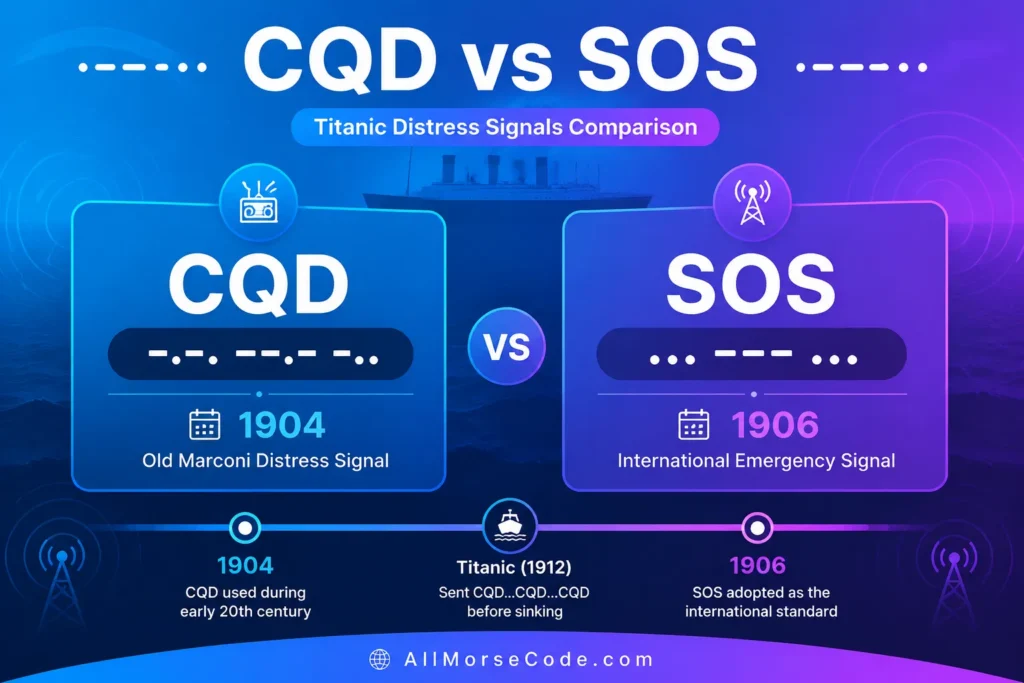
CQD vs. SOS at a Glance
Feature | CQD | SOS |
|---|---|---|
Introduced | 1904, by the Marconi Company | Adopted internationally in 1906 |
Morse Code | -.-. –.- -.. | … — … |
Purpose | Marconi company distress signal | International distress signal |
Used by Titanic | Yes | Yes |
First sent by Titanic | Shortly after the collision | Later during the emergency |
Common Myths About the Titanic’s Morse Code
Myth | Fact |
|---|---|
Titanic only sent SOS | It sent both CQD and SOS. |
SOS means “Save Our Souls” | SOS was selected for its distinctive Morse pattern, not as an official acronym. |
The complete log survived | Only reconstructed records remain. |
Titanic invented SOS | SOS had already been adopted internationally before 1912. |
The Titanic’s distress calls were transmitted over approximately two hours, from shortly after the collision until the ship’s electrical power failed.
Time (Approx.) | Event |
|---|---|
11:40 PM | Titanic strikes an iceberg in the North Atlantic. |
12:15 AM | The first CQD distress calls are transmitted using the ship’s call sign MGY. |
12:25–12:45 AM | Nearby ships acknowledge the distress messages while Titanic continues broadcasting its position. |
~12:45 AM | SOS begins appearing alongside CQD in outgoing transmissions. |
1:20–2:00 AM | Continuous exchanges take place with the RMS Carpathia, Frankfurt, and other ships responding to the emergency. |
~2:17 AM | The final wireless transmissions are sent before the ship loses electrical power. |
2:20 AM | The RMS Titanic sinks beneath the North Atlantic. |
Although the RMS Carpathia was more than 50 miles away, it changed course immediately after receiving the distress calls and arrived several hours later to rescue survivors.
Note: Reported timings vary slightly by source, since ship’s time and New York time differed by roughly two hours and not every log recorded events identically.
No single, complete transcript of every message sent by the RMS Titanic has survived — the wireless equipment and its onboard log went down with the ship. What historians have today comes from wireless logs recorded by nearby ships, official investigations, and testimony from surviving wireless operator Harold Bride. For readers who want to go deeper than a summary, Encyclopedia Titanica’s message board compiles researcher-reviewed comparisons of the surviving message sources, including Mark Baber’s widely cited chronology of messages sent and received during the sinking.
One of the earliest distress calls followed a format similar to:
CQD CQD CQD DE MGY Come at once. We have struck an iceberg. It’s a CQD, old man.
As the emergency worsened, SOS began appearing alongside CQD, making Titanic one of the first ships to use both distress signals during the same disaster. One of the last messages recorded, sent to the Carpathia at around 2:15 AM, combined both signals in a single desperate transmission requesting immediate help as passengers were being loaded into lifeboats.
Rather than a single dramatic message, the transmissions are better understood as an ongoing conversation between the Titanic and nearby ships — the Carpathia acknowledged the distress calls and changed course, while other vessels, including Frankfurt and Olympic, also exchanged wireless messages with the Titanic during the night.
You can experiment with how these historic messages would look and sound using the Morse Code Image Translator or the Morse Code Audio Translator.
Historical Note: Many websites claim to show the “complete Titanic Morse code transcript.” No single, uninterrupted transcript exists. The surviving records are reconstructed from multiple sources — wireless logs kept by other ships, newspaper reports, and testimony from the British and American official inquiries — which is why exact wording sometimes differs between accounts.
The Titanic’s Morse code messages represent one of the most significant moments in the history of wireless communication. By transmitting CQD and SOS, Jack Phillips and Harold Bride helped alert nearby ships and played a vital role in the rescue of more than 700 survivors. Although the complete wireless log was lost with the ship, the surviving records — preserved through inquiries, ship logs, and firsthand accounts — continue to offer valuable insight into the final hours of the disaster.
If you’d like to explore Morse code further, our complete guide to Morse code and the Morse Code Audio Translator are great next steps for learning how this historic communication system still works today.

Steve Jhonson
Founder of AllMorseCode.com and creator of educational Morse code resources used by learners worldwide. Specializes in Morse code translation, signal encoding concepts, communication history, and practical learning methods. Publishes in-depth guides, reference materials, and interactive tools that make Morse code simple, accurate, and accessible for students, amateur radio enthusiasts, emergency preparedness learners, and everyday users.