D in Morse Code: What It Means and How to Remember It
D in Morse code is -.. — one dash followed by two dots, commonly remembered as dah-di-dit or long-short-short. It’s a short, three-signal pattern, which makes it a good letter to compare against B, K, and G three other letters that share part of the same shape. This guide covers the rhythm, timing, the letters D is most often confused with, and a fact about D you probably haven’t seen elsewhere.
D is one small piece of a much larger system for the full picture of how every letter fits together, the complete Morse code guide covers the basics before you zoom into individual letters.
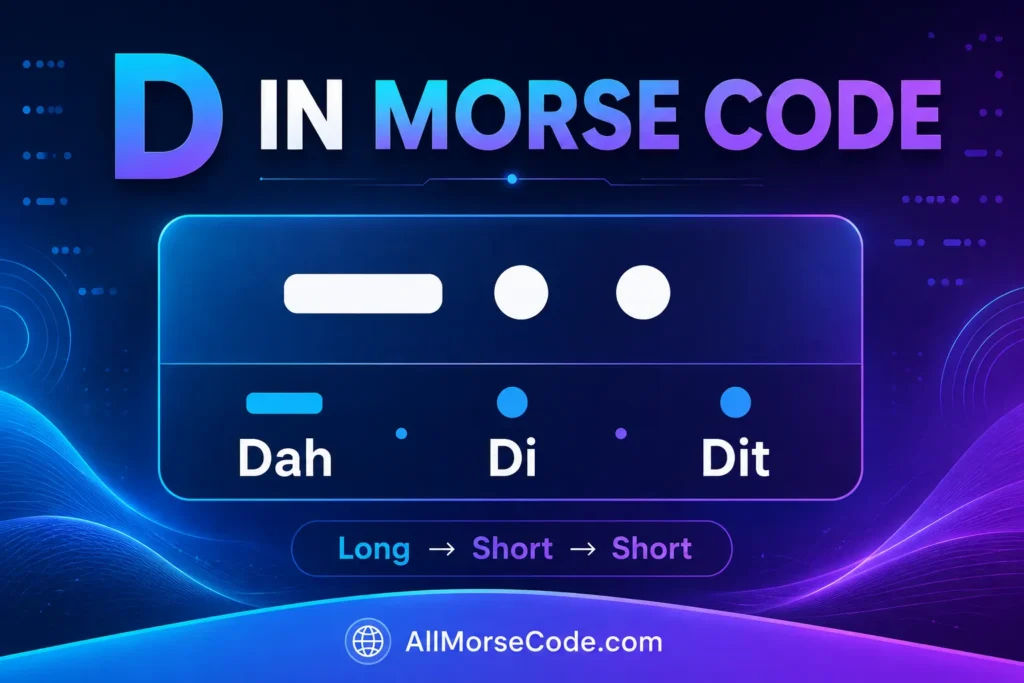
The Morse code for D is:
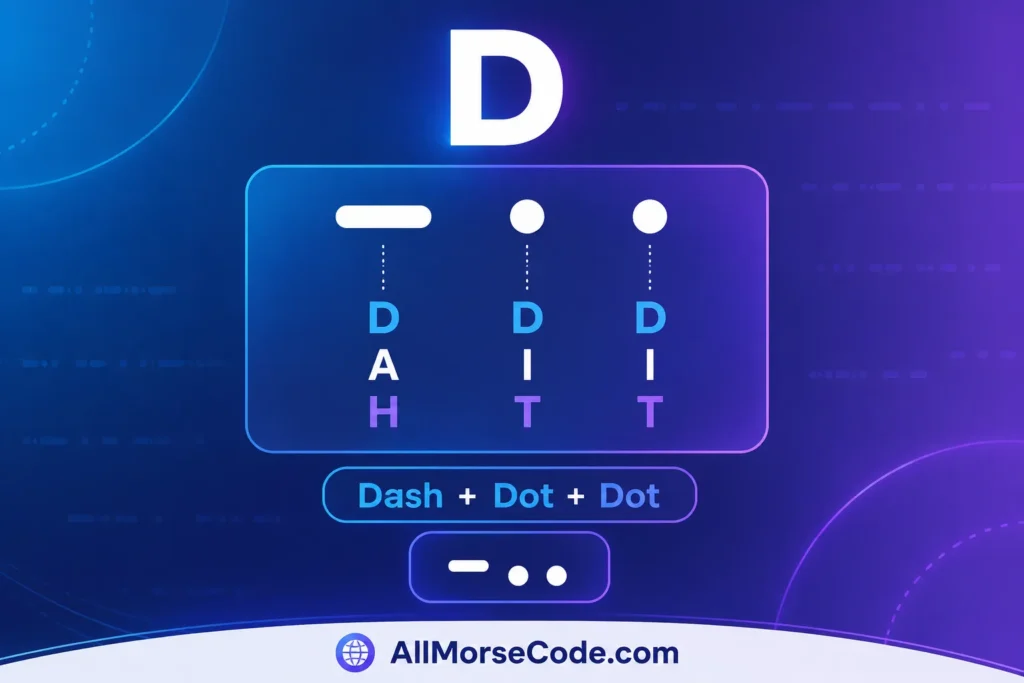
D = -..
It’s built from three signals — one dash followed by two dots always sent in that exact order. Change any one signal and you get a different letter entirely (more on that below).
D is part of International Morse Code, the same standardized system covered on the main Morse code guide.
Why Is D -.. ? The Letter Ham Radio Operators Use to Say “From”
D has a role in modern amateur radio that goes beyond just spelling words. Combined with E, it forms DE (-.. .) — one of the oldest and most widely used prosigns in Morse communication, meaning “from.” When an operator calls CQ (the general “calling anyone” signal), the standard next step is to send DE followed by their own callsign — for example, “CQ CQ DE W1AW” identifies who’s making the call. This convention dates back to 1860s wired telegraphy and carried straight over into radio, where it’s still used exactly the same way today.
That makes D one of a small handful of letters, alongside C, that pulls double duty: it’s both an ordinary letter for spelling words and a building block of one of Morse’s most-used procedural signals.
Quick Reference
Item | Answer |
|---|---|
Letter | D |
Morse Code | -.. |
Pattern | Dash + two dots |
Sound | Dah-di-dit |
First signal | Dash (3 units) |
Following signals | Two dots (1 unit each) |
Timing pattern | 3-1-1 |
However you’re using it on paper, out loud, or over a signal the pattern for D never changes.
Written: -.. Spoken rhythm: dah-di-dit (long → short → short) Tapped, flashed, or toned: one long pulse, then two short pulses
When D appears next to other letters, a space separates each letter so the pattern stays readable:
DOG = -.. — –.
If reading “-.. — –.” off the page doesn’t click yet, running it through the Morse code audio translator turns it into the actual long-short-short tone pattern, and the Morse code translator will convert any word you type into its dot-dash form so you can see D next to other letters instantly.
D in Morse Code Timing
Timing is what keeps the dash and the two dots inside D distinguishable from each other:
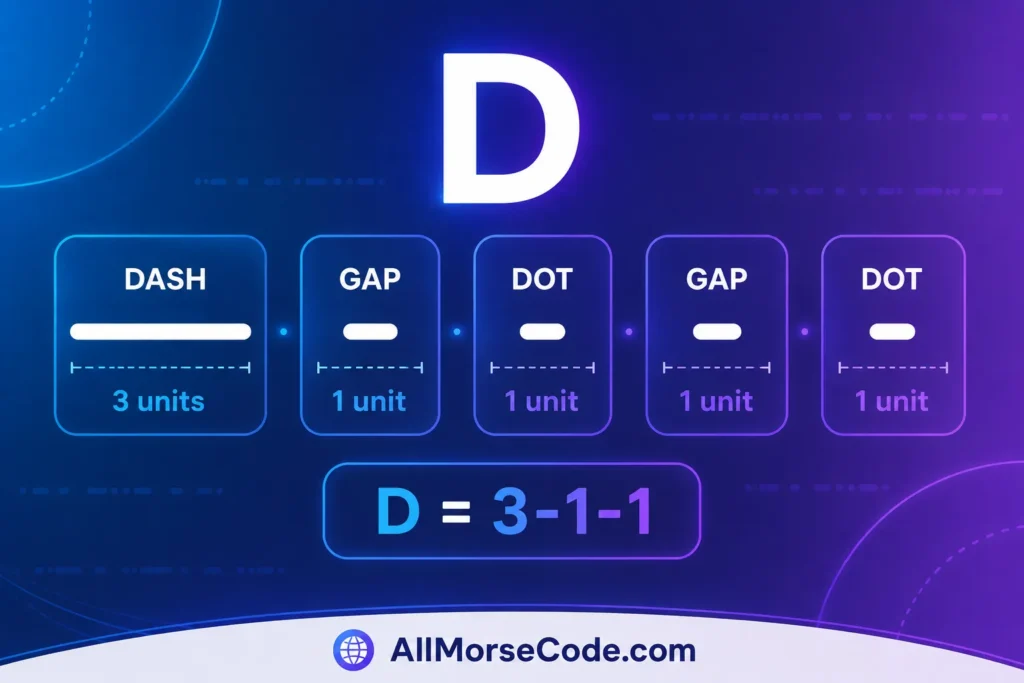
Element | Duration |
|---|---|
Dash | 3 units |
Each dot | 1 unit |
Gap between signals within D | 1 unit |
So the full duration pattern for D reads 3-1-1. Transmission speed can vary, but that ratio stays fixed the same timing system that governs every letter across the full Morse code alphabet, not just D.
D vs. B, K, and G — and Other Letters Built From Similar Signals
D is easy to confuse with a few other letters, since Morse reuses the same basic signals in different lengths and orders. Mixing these up is the most common beginner mistake with D.
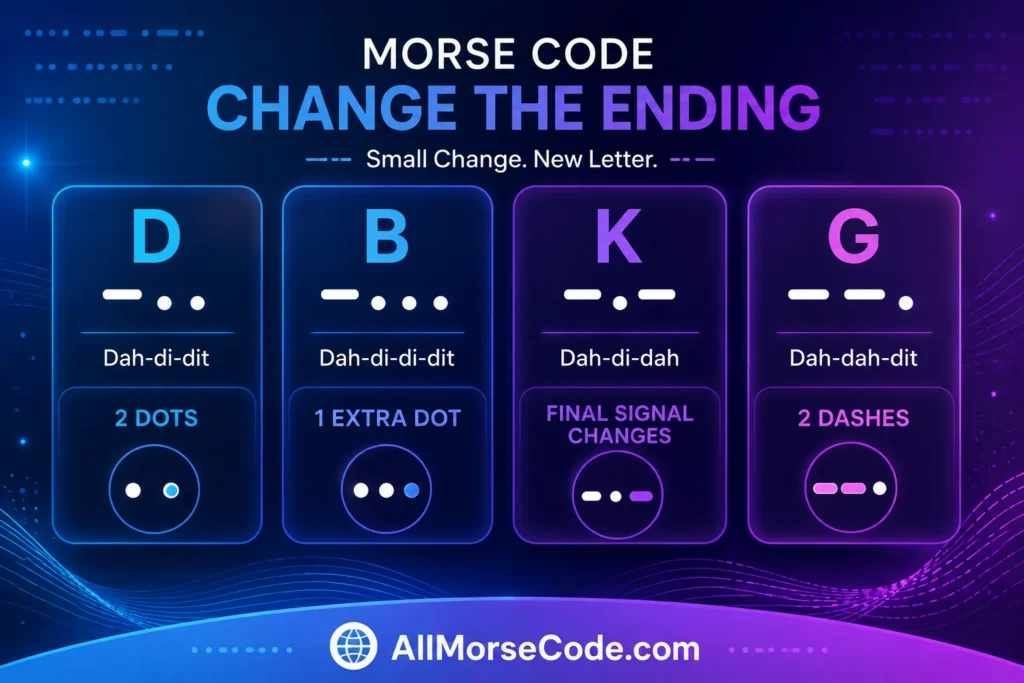
Letter | Morse Code | Pattern |
|---|---|---|
D | -.. | dash + 2 dots |
B | -… | dash + 3 dots (one dot longer than D) |
K | -.- | dash + dot + dash |
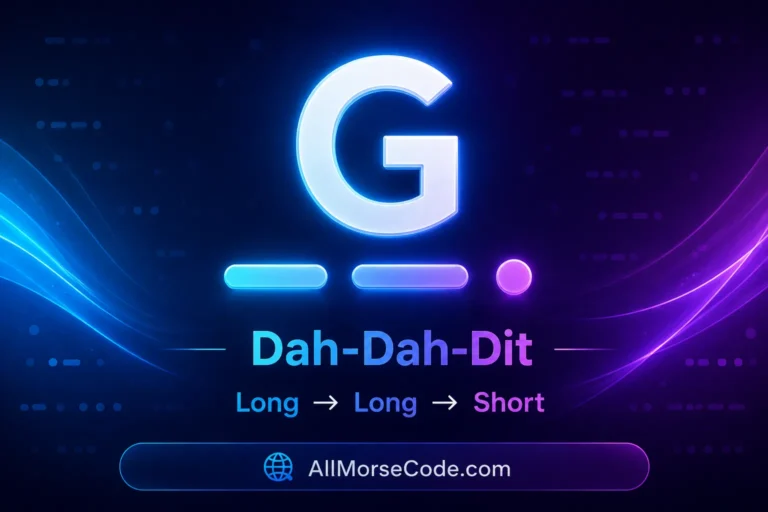
G | –. | 2 dashes + dot |
U | ..- | 2 dots + dash |
R | .-. | dot + dash + dot |
Three comparisons matter most:
For the complete picture of how D fits alongside every other character, see the full Morse code alphabet.
D in Example Words
D doesn’t change no matter what surrounds it — only the spacing between letters does:
Text | Morse Code |
|---|---|
D | -.. |
DO | -.. — |
DAY | -.. .- -.– |
DOG | -.. — –. |
These are just a starting point. Once single letters feel automatic, a much larger set of Morse code words is worth practicing including common phrases like HELLO or GOODBYE. That’s also the point where beginners start wondering how experienced Morse code operators hear words as whole rhythms instead of decoding letter by letter — the natural next skill after this one.
Is D Used in Real Morse Communication?
Yes D is sent exactly as -.. whenever it occurs naturally in a message, no different from any other letter. It also plays a functional role beyond spelling, thanks to the DE prosign explained above. D appears inside other procedural signals and shorthand too, and those combinations carry entirely different meanings from the standalone letter. Many common Morse code abbreviations embed D’s pattern inside a completely different multi-letter meaning, so don’t confuse a longer sequence that contains -.. with D itself. D is also unrelated to universally recognized signals like SOS, which is built from S and O, not D.
If you ever want to send D (or a full message) using real equipment instead of just reading it, the guide to Morse code machines covers how physical senders and keys work.
D in Morse code is -.. — dash, dot, dot, or dah-di-dit. The fastest way to make it permanent isn’t re-reading the symbol, it’s practicing the rhythm by ear or by tapping especially alongside B, K, and G, its closest look-alikes until -.. stops feeling like a code to solve and starts feeling like a sound you simply recognize.