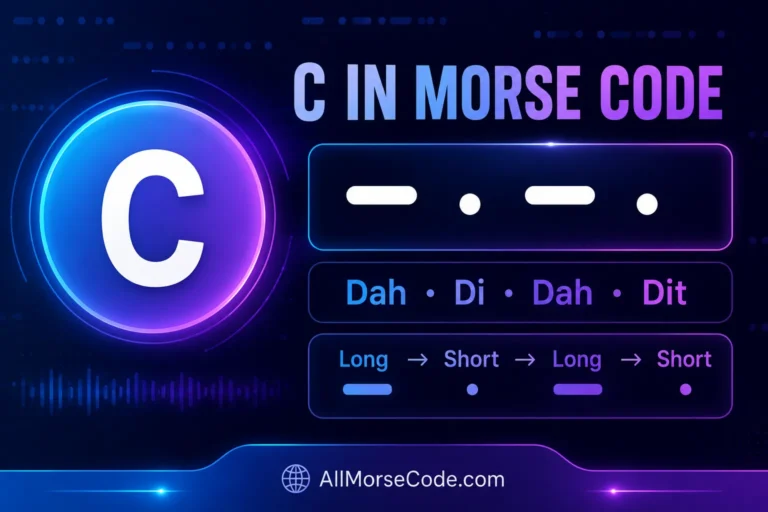
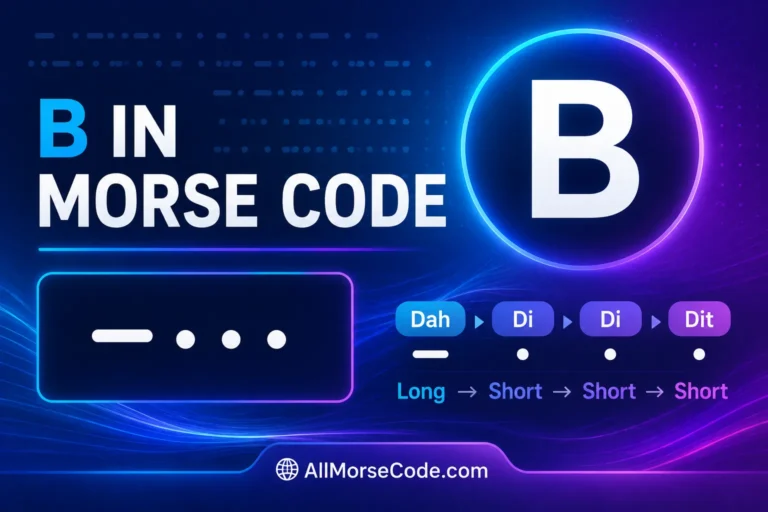
E in Morse Code: What It Means and How to Remember It
E in Morse code is . — a single dot, commonly remembered as dit. It’s the shortest character in the entire Morse alphabet, with no second signal to add. That simplicity makes E an easy starting point, but it also creates a real practical challenge worth knowing about — covered below.
E is one small piece of a much larger system for the full picture of how every letter fits together, the complete Morse code guide covers the basics before you zoom into individual letters.
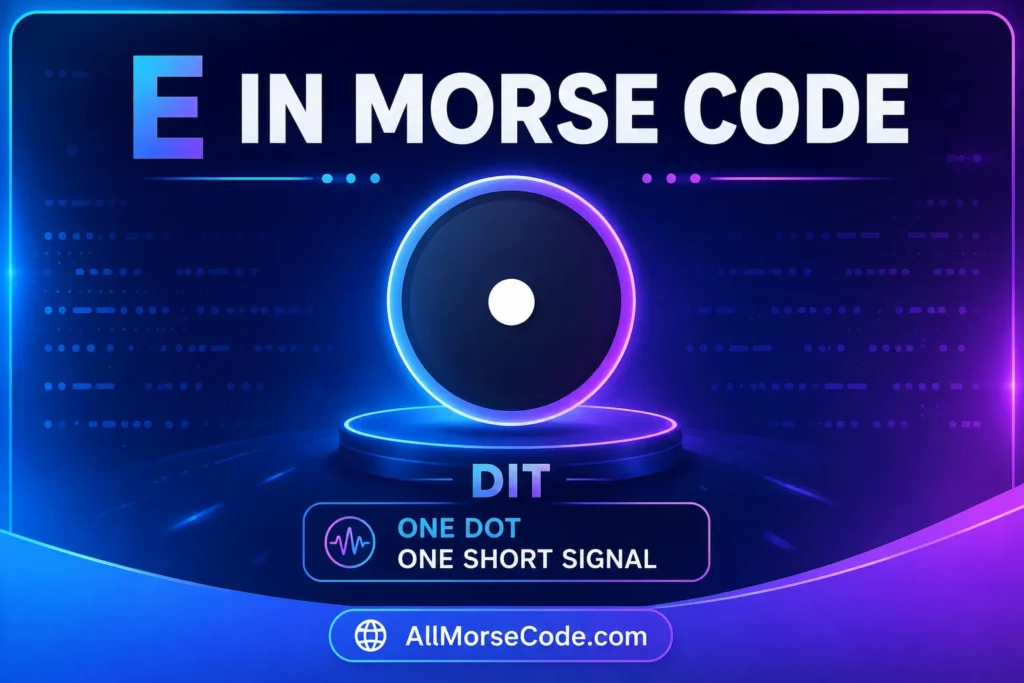
The Morse code for E is:
E = .
It’s a single signal one dot, nothing else. There’s no dash, no second element, and no internal order to remember, which makes E unique among Morse letters.
E is part of International Morse Code, the same standardized system covered on the main Morse code guide.
The Shortest Letter’s Hidden Challenge
E’s single dot makes it the fastest letter in Morse code to send at a brisk 20 words per minute, it lasts roughly 60 milliseconds, quicker than the blink of an eye. But that same brevity makes E the letter most likely to get swallowed by static, weak signal strength, or a slightly rushed sender. A dash-heavy letter like O or a longer letter like H gives an operator several elements to catch even if part of the signal is lost in noise; E offers exactly one chance.
Because of this, experienced radio operators rarely identify E by consciously “counting” a dot the way a beginner does. Instead, they recognize it from the shape and rhythm of the word around it he same way a fluent reader doesn’t sound out each letter of a familiar word. This is one of the clearest examples of why Morse fluency is ultimately about pattern recognition, not signal-by-signal decoding the same shift covered in how experienced Morse code operators hear words.
Quick Reference
Item | Answer |
|---|---|
Letter | E |
Morse Code | . |
Pattern | One dot |
Sound | Dit |
Number of signals | 1 |
Duration at 20 WPM | ~60 milliseconds |
However you’re using it — on paper, out loud, or over a signal — the pattern for E never changes.
Written: . Spoken rhythm: dit (one short sound) Tapped, flashed, or toned: a single short pulse
When E appears next to other letters, a space separates each letter so the pattern stays readable:
BE = -… .
If reading “-… .” off the page doesn’t click yet, running it through the Morse code audio translator turns it into the actual short dit sound, and the Morse code decoder will convert any word you type into its dot-dash form so you can see E next to other letters instantly.
E in Morse Code Timing
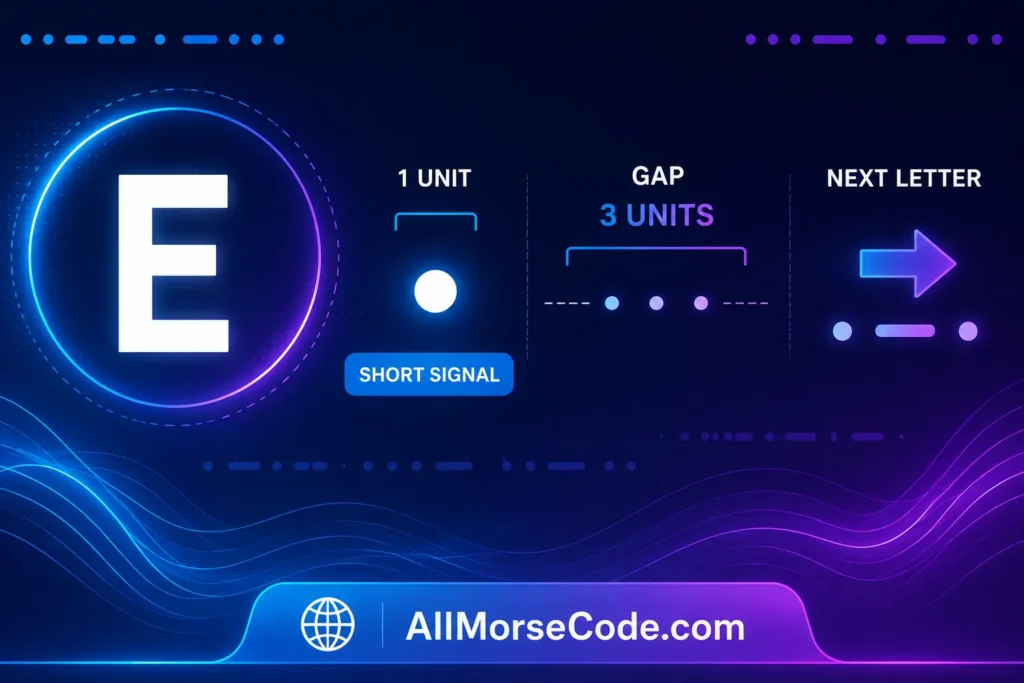
Because E is only one element, its timing is the simplest of any letter — but that simplicity comes with a catch:
| Element | Duration |
| Dot | 1 unit |
| Internal gap | none — E has only one signal |
| Gap before the next letter | 3 units |
There’s nothing to sequence within E itself. The only thing that matters is the space around it — without a proper gap on either side, a lone E can blur into a neighboring dot from a different letter, or into part of a longer dot-only letter like I, S, or H.
E vs. T, I, S, and H — Letters Built From a Single Repeating Signal
E sits at the start of two important comparison groups: one with T (the only other single-signal letter), and one with I, S, and H (letters built purely from repeating dots).
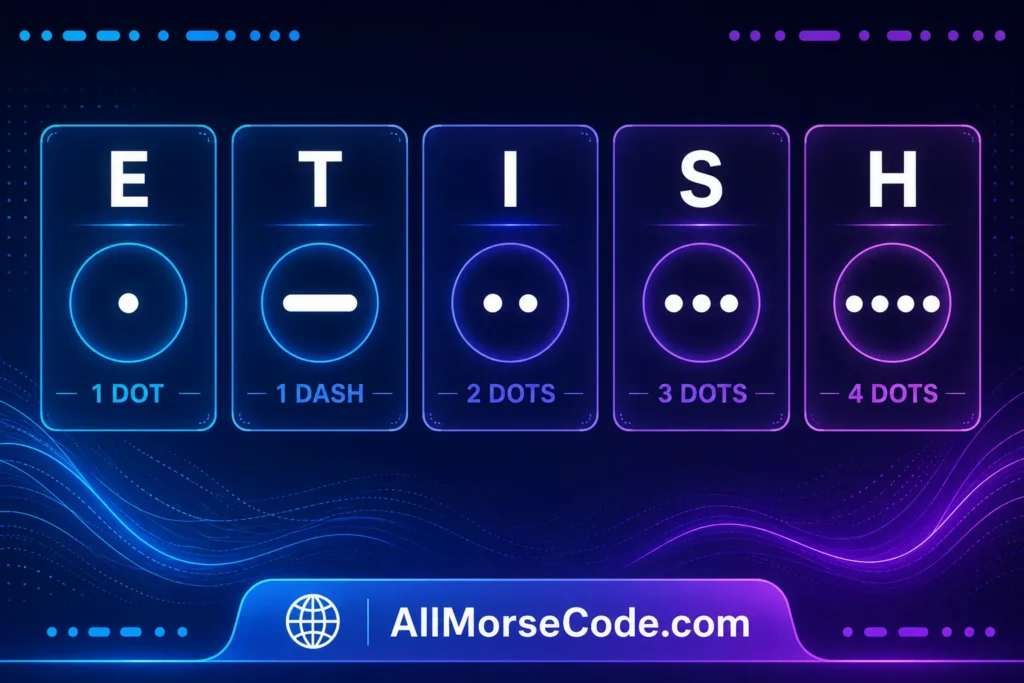
Letter | Morse Code | Pattern |
|---|---|---|
E | . | one dot |
T | – | one dash |
I | .. | two dots |
S | … | three dots |
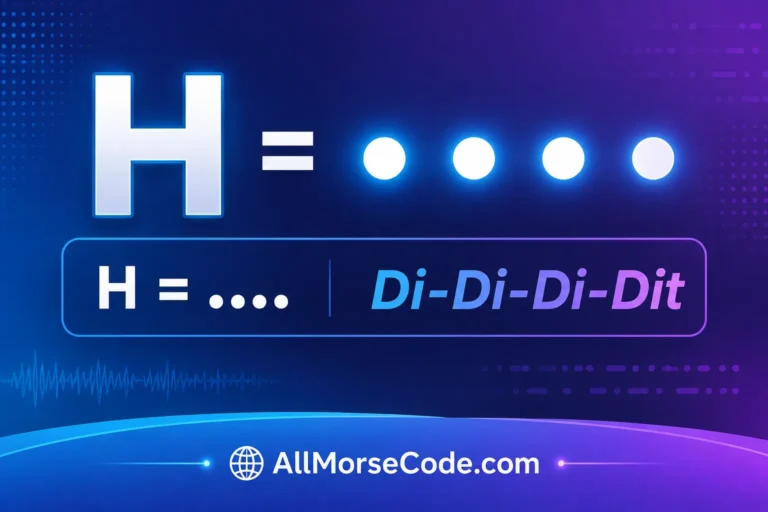
H | …. | four dots |
Two comparisons matter most:
For the complete picture of how E fits alongside every other character, see the full Morse code alphabet.
E in Example Words
E doesn’t change no matter what surrounds it — only the spacing between letters does:
Text | Morse Code |
|---|---|
E | . |
BE | -… . |
DE | -.. . |
SEE | … . . |
These are just a starting point. Once single letters feel automatic, a much larger set of Morse code words is worth practicing — including common phrases like HELLO or GOOD MORNING, both of which lean heavily on E.
Is E Used in Real Morse Communication?
Yes — E is sent exactly as . whenever it occurs naturally in a message, no different from any other letter, and because it’s the most frequent letter in English, it shows up constantly in real transmissions. E also appears as a building block inside procedural signals — for example, it’s the second half of DE (-.. .), the ham radio prosign meaning “from,” used right after calling CQ to identify the sender. Don’t confuse a longer sequence that contains a dot with E itself; for more on these shorthand combinations, see Morse code abbreviations. E is also unrelated to universally recognized signals like SOS, which is built from S and O, not E.
If you ever want to send E (or a full message) using real equipment instead of just reading it, the guide to Morse code machines covers how physical senders and keys work.
E in Morse code is . — one dot, dit, nothing more. It’s the simplest letter to learn but, ironically, one of the trickier ones to catch reliably in real conditions, which is exactly why experienced operators recognize it by context rather than by counting. Compare it with T to understand the dot-versus-dash split, and with I, S, and H to get comfortable hearing runs of dots — and E stops being a signal to decode and becomes a sound you simply recognize.