What is Morse Code ? — Complete Guide for Beginners
Morse code is one of those things most people have heard of, but very few truly understand. You’ve probably seen dots and dashes before, maybe in movies or emergency signals like SOS, and wondered how they actually work. The problem is, most explanations online are either too technical or too basic, leaving beginners confused.
Most guides either go too deep or stay too basic. This one keeps things simple while still showing you how Morse code actually works. Instead of overwhelming you with history or theory, you’ll learn exactly what Morse code is, how it works, why it was invented, and how people still use it today in a way that actually makes sense. By the end, you’ll not only understand Morse code, but also recognize patterns, read simple messages, and even start learning it yourself.
Try our free Morse code translator to convert any text to Morse code instantly. You can also decode Morse audio using our Morse code audio translator or scan Morse patterns from images with the Morse code image translator.
[ez-toc]
Morse code is a method of sending information using two types of signals: dots and dashes. These signals can be transmitted as sound, light, or electrical pulses.
Each letter in the alphabet and each number is represented by a unique combination of these signals. For example, the letter “A” is a dot followed by a dash (· −), while “B” is a dash followed by three dots (− · · ·).
Instead of using spoken or written language directly, Morse code works as an encoding system. It converts letters into signals that can travel long distances, even with very simple technology.
It works by combining short signals (dots) and long signals (dashes) in a specific order. The meaning depends on both the pattern and the timing.
Here’s how it breaks down:
For example:
This timing system is what makes Morse code readable, whether it’s sent through sound, light flashes, or radio signals.
Morse code is not a language. It’s a system used to represent languages.
Think of it like this:
The same Morse code sys
It has been used in many real-world situations, especially where simple communication is needed.
Common uses include:
Even today, Morse code is valued because it works when other systems fail.
Morse code was invented in the 1830s by Samuel Morse and Alfred Vail. It was created to work with the telegraph, one of the first long-distance communication technologies.
Before Morse code, sending messages over long distances was slow and unreliable. The telegraph changed that, but it needed a simple way to encode messages and that’s where Morse code came in.
It allowed people to send messages quickly using electrical signals, which was revolutionary at the time.
Morse code assigns a unique pattern of dots and dashes to every letter and number.When you first look at Morse code, it can feel confusing. But once you recognize patterns like SOS, it starts to make sense quickly.
Examples:
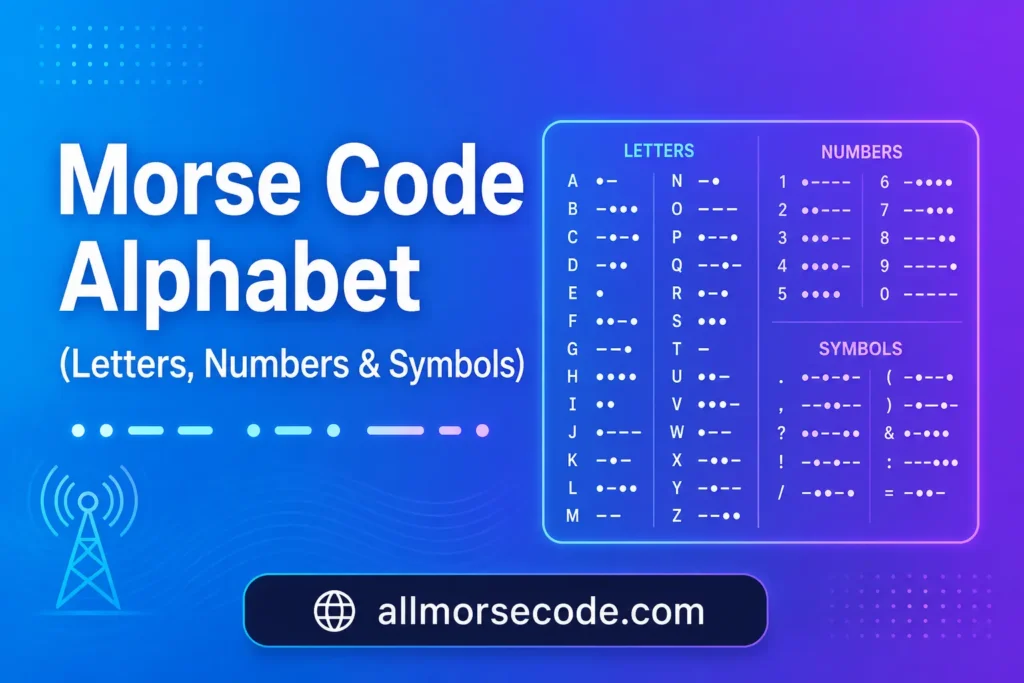
Morse Code Alphabet
| Letter | Morse Code |
|---|---|
| A | .- |
| B | -… |
| C | -.-. |
| D | -.. |
| E | . |
| F | ..-. |
| G | –. |
| H | …. |
| I | .. |
| J | .— |
| K | -.- |
| L | .-.. |
| M | — |
| N | -. |
| O | — |
| P | .–. |
| Q | –.- |
| R | .-. |
| S | … |
| T | – |
| U | ..- |
| V | …- |
| W | .– |
| X | -..- |
| Y | -.– |
| Z | –.. |
This system is standardized as International Morse Code, which is used worldwide.
Learning the alphabet is the first step to reading and writing Morse code.
Morse Code Numbers
| Number | Morse Code |
|---|---|
| 0 | —– |
| 1 | .—- |
| 2 | ..— |
| 3 | …– |
| 4 | ….- |
| 5 | ….. |
| 6 | -…. |
| 7 | –… |
| 8 | —.. |
| 9 | —-. |
Morse code Symbols
| Symbol | Morse Code |
|---|---|
| Period (.) | .-.-.- |
| Comma (,) | –..– |
| Question (?) | ..–.. |
| Exclamation (!) | -.-.– |
| Slash (/) | -..-. |
| Hyphen (-) | -….- |
| At sign (@) | .–.-. |
| Apostrophe (‘) | .—-. |
| Colon (:) | —… |
| Equals (=) | -…- |
| Plus (+) | .-.-. |
Some patterns in this code are widely recognized because they are used frequently.
Examples of Morse Code Messages
SOS (Distress Signal)
· · · — — — · · ·
HELLO
H: · · · ·
E: ·
L: · − · ·
L: · − · ·
O: − − −
OK
O: − − −
K: − · −
Example:
Other examples:
Seeing real words helps you understand how Morse code works in practice, not just theory.
For romantic Morse code messages, explore I love you in Morse code and For longer emotional phrases try I miss you in Morse code.
A Morse code translator is a tool that converts regular text into Morse code and vice versa.
For example:
These tools are useful for:
tem can represent many different languages.
Yes, Morse code is still used today, although not as widely as before.
It is still found in:
Its simplicity makes it reliable when modern technology fails.
Morse code can also be communicated using eye blinking.
In this method:
This technique has been used by people with limited mobility to communicate, making Morse code an important accessibility tool.
Even in a world of smartphones and the internet, Morse code still has value.
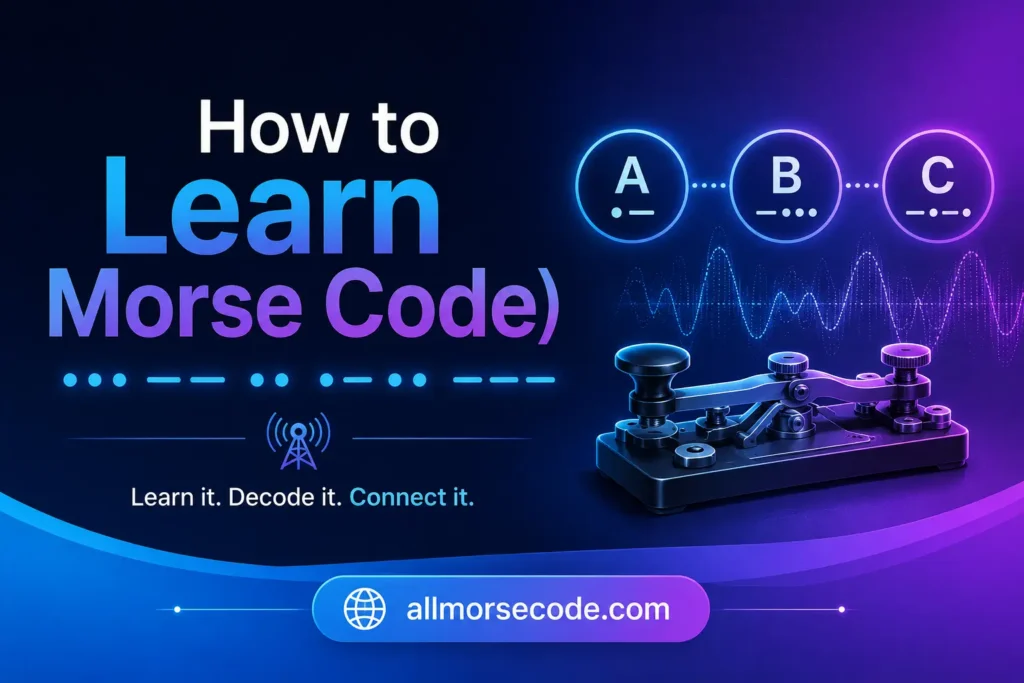
Learning Morse code doesn’t have to be difficult.Start with simple phrases like hi in Morse code, yes in Morse code, and no in Morse
code before moving to longer words.
Start with these steps:
- Learn the most common letters (E, T, A, N)
- Practice listening to dots and dashes
- Use repetition and simple words
- Practice daily for a few minutes
The key is consistency, not memorizing everything at once.
It works:
It’s simple, reliable, and can be used almost anywhere.
A Morse code chart is a quick reference that shows all letters and their patterns.
Using a chart helps you:
Get a clean, printable Morse code chart with letters, numbers, and symbols for easy reference.
| Frequency | Letters | Pattern Length |
|---|---|---|
| Most common | E, T | 1 unit |
| Common | A, I, N, M, S, U | 2 units |
| Less common | D, G, K, O, R, W | 2–3 units |
| Rare | J, Q, X, Y, Z | 4 units |
For example, E (most common letter in English) is just one dot, while Q (rare) needs four signals (——·—).
Morse Code Spacing Rules
Reading Morse correctly depends on timing, not just knowing the dot-dash patterns:
| Element | Duration | Example |
|---|---|---|
| Gap between dots/dashes (within a letter) | 1 unit | A = ·— (dot + gap + dash) |
| Gap between letters | 3 units | HI = ···· ·· |
| Gap between words | 7 units | HI / THERE |
This timing is defined by the ITU in Recommendation M.1677-1. At 5 WPM, one unit ≈ 240 milliseconds; at 20 WPM, one unit ≈ 60 milliseconds. The ratio stays the same at any speed that’s why Morse stays readable whether sent slow or fast.
Morse code may seem like an old communication system, but it’s still surprisingly useful and relevant today. Once you understand how dots and dashes form letters and words, it becomes much easier to see why it played such an important role in history and why it still matters. With a bit of practice, anyone can start recognizing patterns and even use Morse code in real situations.

Steve Johnson
Founder of AllMorseCode.com and creator of educational Morse code resources used by learners worldwide. Specializes in Morse code translation, signal encoding concepts, communication history, and practical learning methods. Publishes in-depth guides, reference materials, and interactive tools that make Morse code simple, accurate, and accessible for students, amateur radio enthusiasts, emergency preparedness learners, and everyday users.