SOS Morse Code: Meaning, History & How to Signal for Help
There was a time when I thought SOS simply meant “Save Our Souls.” Most people still believe that. But the moment you actually look into Morse Code, you realize SOS is something far more practical and potentially life-saving. It’s not just a phrase. It’s a distress signal designed to be impossible to misunderstand, even in the worst conditions.
I remember being on a hiking trail with no signal, stuck during a power outage, or imagined being stranded somewhere unfamiliar, this matters more than you think. Knowing how SOS morse code works isn’t trivia it’s a basic form of emergency communication that can still save lives today, even in a world full of smartphones.
[ez-toc]
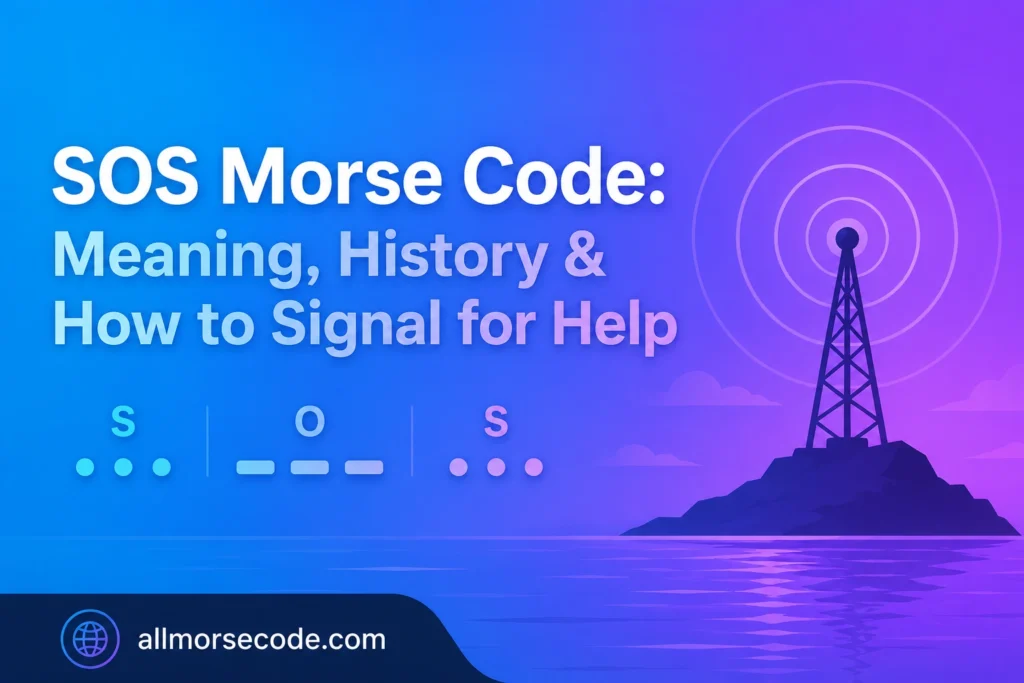
SOS is a distress signal represented in Morse code as:
Three dots, three dashes, three dots (··· − − − ···)
It’s designed to be:
Unlike normal Morse code letters, SOS is sent as a continuous signal, also known as a prosign.
Use our free Morse code decoder to convert any emergency phrase into Morse code instantly.
Despite popular belief, SOS does not stand for anything.
Phrases like:
were created later as backronyms to help people remember the signal.
The real reason SOS exists is because of its simple and unmistakable pattern, not because of any abbreviation.
The SOS distress signal didn’t appear overnight it was the result of early problems in wireless communication at sea, where unclear signals often led to confusion during emergencies.
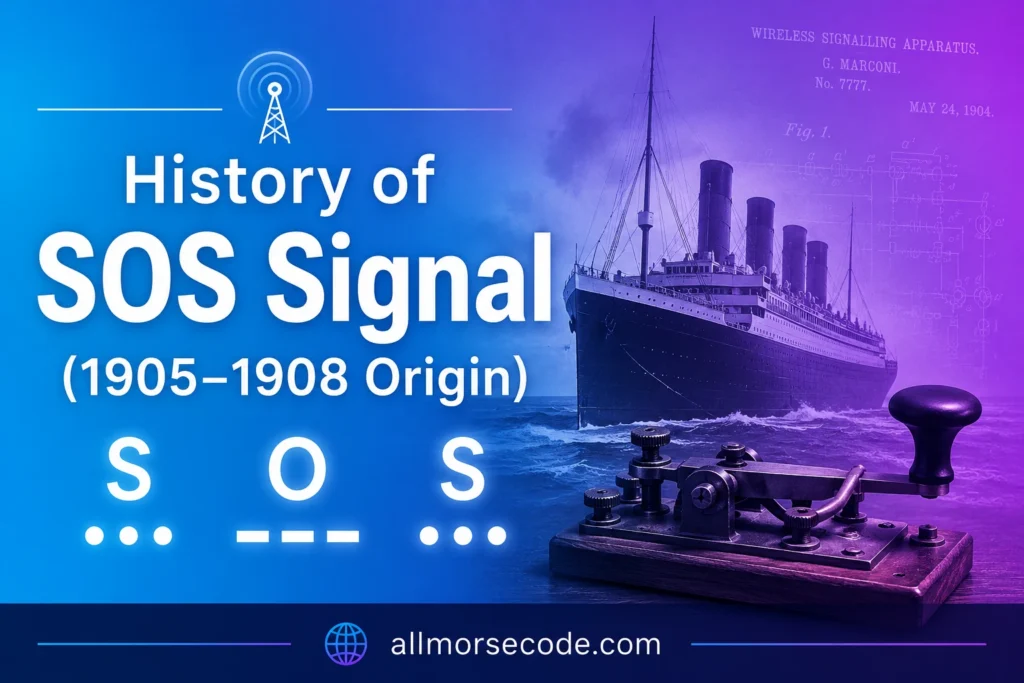
In the early 1900s, ships relied on Morse code sent via radio waves, but there was no universal distress signal. One of the first widely used signals was CQD, introduced by the Marconi Company around 1904. While CQD roughly meant “All stations: distress,” it had a major flaw it wasn’t simple or distinct enough in urgent situations, especially when signals were weak or operators were under stress.
SOS Timeline
To fix this, a clearer and more standardized signal was needed. That solution came during the International Radiotelegraph Convention, where global communication authorities agreed on a universal distress signal: SOS (··· − − − ···).
The choice wasn’t based on meaning it was based on efficiency:
By 1908, SOS was officially implemented worldwide as the standard maritime distress signal, replacing CQD across international waters.
One of the most famous early uses of SOS happened during the RMS Titanic disaster, where both CQD and SOS were sent by radio operators. This event highlighted the importance of a clear, universal emergency signal and helped cement SOS as the global standard.
From that point on, SOS became deeply embedded in maritime communication, aviation systems, and emergency response protocols, remaining one of the most recognized distress signals in history. For a complete overview of Morse code origins, read our guide on the history of Morse code.
SOS wasn’t chosen randomly. It was selected because:
In Morse code, clarity matters more than meaning, which is why SOS morse code was chosen over more complex signals.
This is where most guides fail they explain SOS but don’t show how to actually use it.
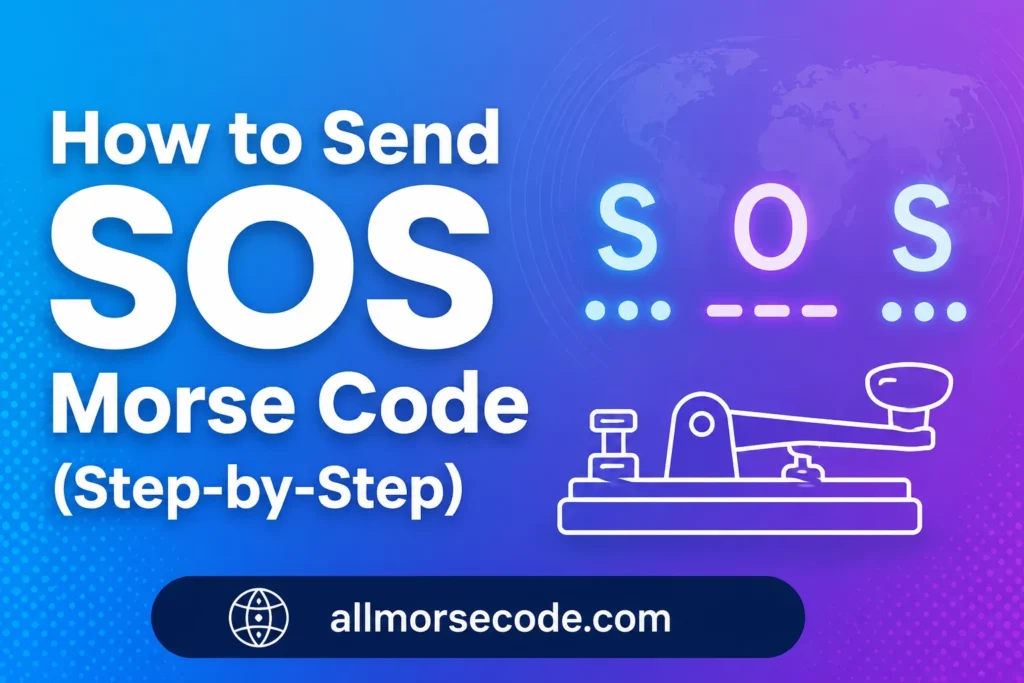
SOS Signal Pattern
Dot (·) = Short signal
Dash (—) = Long signal
Pattern: ··· − − − ···
Repeat continuously until help arrives.
SOS Using Light (Flashlight or Phone)
Repeat until help arrives.
This works well with:
SOS Using Sound (Whistle or Tapping)
Useful in:
SOS Using Radio
When using radio:
This is still used in aviation and maritime distress systems.
To decode SOS from an audio recording, try our tool to decode Morse audio online.
SOS Using Ground Signals (Visual Marking)
In open environments, you can create SOS using rocks, sticks, or footprints. Make large visible marks in the pattern “SOS” or three short, three long, three short lines. This is especially useful for aerial rescue situations.
Imagine:
In these cases, SOS becomes a universal language of survival.
Rescue teams are trained to recognize these patterns quickly, making it one of the most reliable survival signals ever created.
Signal | Type | Usage | Status |
|---|---|---|---|
SOS | Morse Code | Light, sound, radio | Still used |
Mayday | Voice Call | Radio communication | Widely used |
CQD | Morse Code | Early radio distress | Obsolete |
Mayday distress calls are easier to speak, but SOS is more reliable in non-verbal situations.
Code | Meaning |
|---|---|
··· − − − ··· | SOS — universal distress signal |
-.-. –.- | CQ — calling all stations |
… — … -.-. | SOSC — distress continuation |
Yes just in different forms.
Modern devices include:
Even though technology has evolved, the concept of quick distress signaling remains the same.
SOS morse code is still one of the most recognized emergency signals worldwide.
SOS looks simple, but that simplicity is exactly why it has lasted for over a century. From early radio signals to modern emergency features, it remains one of the most reliable ways to ask for help when everything else fails. Knowing it isn’t just interesting it’s something that could genuinely make a difference in a real situation.
Try the free Morse Code Translator at AllMorseCode.com to convert any word or phrase into Morse code instantly and hear the audio signal.

Steve Johnson
Founder of AllMorseCode.com and creator of educational Morse code resources used by learners worldwide. Specializes in Morse code translation, signal encoding concepts, communication history, and practical learning methods. Publishes in-depth guides, reference materials, and interactive tools that make Morse code simple, accurate, and accessible for students, amateur radio enthusiasts, emergency preparedness learners, and everyday users.